September 11, 2026 • Tomás Guerreiro • 10 min reading time • Specs verified June 18, 2026
The Complete Valve Manifold Parts List: Build a 2–6 Zone Assembly Without a Second Supply-House Trip
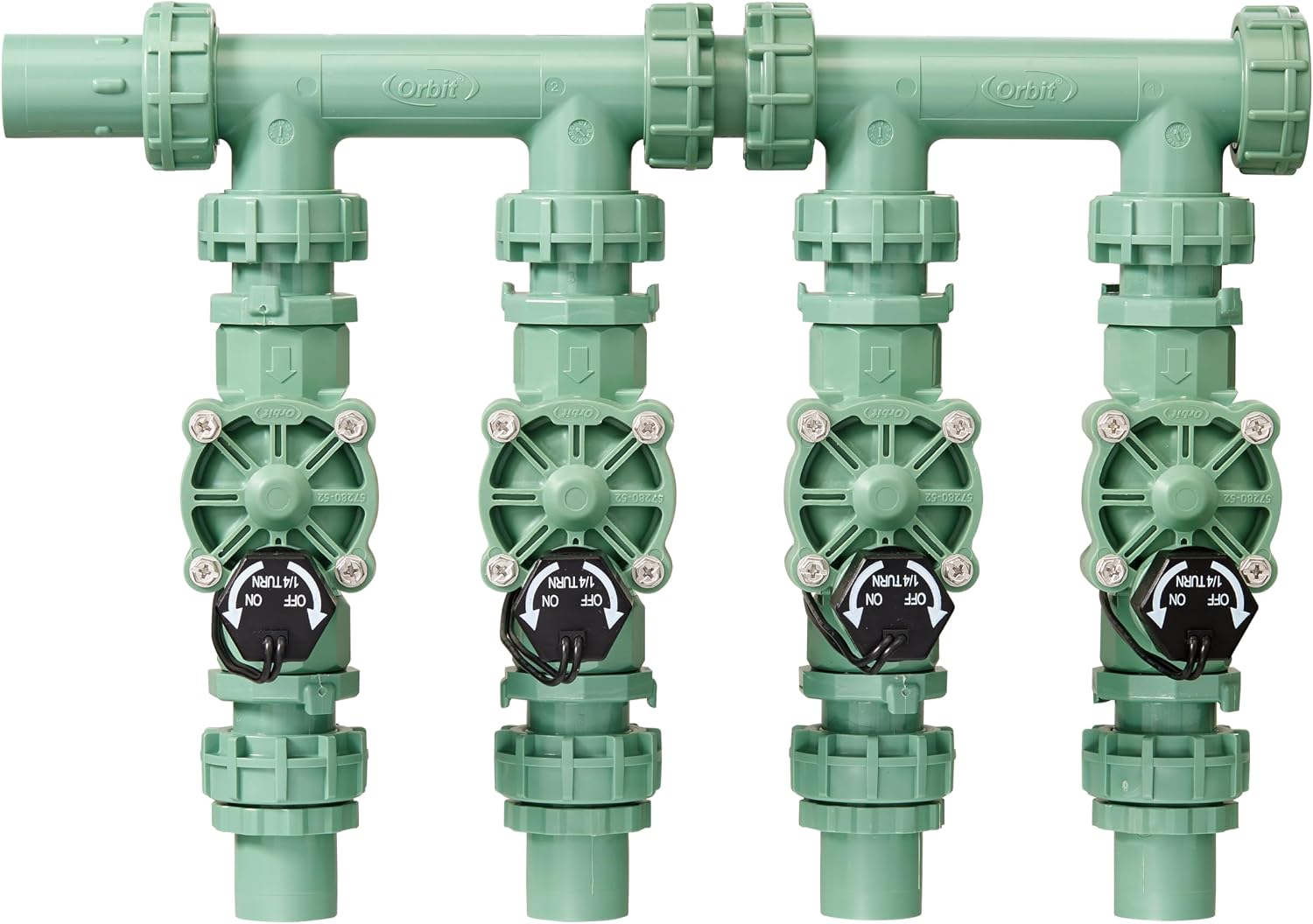
You’re standing in the supply house parking lot at 7:45 a.m., parts list on your phone, and you’ve done this before — you’ll get home, cut into the mainline, and realize you’re missing one brass nipple or the right manifold end cap. That second trip kills half a day. This article is the checklist that stops that from happening.
A valve manifold is simply a group of individual zone valves — the electrically operated on/off valves that send water to each watering zone — assembled onto a shared supply pipe so they share one connection to your mainline. Instead of burying five separate valves in five separate boxes across the yard, you centralize everything in one location, usually near the water source. It’s neater, easier to service, and much easier to wire. If you’re building a 2–6 zone system (or retrofitting an existing one), this guide gives you every component, the logic behind each, the pressure math you need to size it correctly, and a clear decision tree so you can place one complete order.
Why the Manifold Fails Before It’s Even Built: The Parts Gap Problem
The single most common mistake intermediate installers make isn’t a design error — it’s an incomplete initial parts list. You spec the valves and the controller, but you forget the schedule-80 nipples that connect valves to the manifold tee, or you buy ¾-inch threaded fittings when your PVC tee is slip-fit. The Rain Bird Corporation’s valve installation technical guide specifically flags “improper inlet/outlet connection types” as a leading cause of early valve leaks — meaning the failure was a shopping error, not an installation error.
The fix is to spec every component in three layers before you order anything:
- Supply side — mainline tap through the manifold header
- Valve body — the valve itself plus its wiring connections
- Zone outlet — valve exit fittings into each lateral line
Work through these layers in order and the gaps disappear.
The Full Parts List, Zone by Zone
Below is a complete component list for a 4-zone manifold as the worked example. Scale up or down by adding or subtracting valve quantities and the fittings that accompany each. Every item is called out with the spec decision you need to make.
Supply-Side Components (One Per Manifold Assembly)
1. Backflow preventer or PVB (pressure vacuum breaker) Required in virtually every jurisdiction before any irrigation system. A pressure vacuum breaker (PVB) — a device that prevents contaminated irrigation water from being drawn back into your drinking water supply — must be installed upstream of everything else. The EPA WaterSense program’s irrigation systems documentation explicitly identifies backflow prevention as a non-negotiable first component in any residential irrigation system tied to a potable supply. Size it to match your mainline: ¾-inch is standard for residential; 1-inch if your service line and flow budget support it.
2. Isolation ball valve (1 per manifold) A full-port brass ball valve directly downstream of your backflow preventer lets you shut off the entire manifold for service without killing water to the house. Buy ¾-inch or 1-inch to match. Do not substitute a gate valve — gate valves degrade and are harder to operate under pressure.
3. Manifold header pipe This is the “trunk” that feeds all valves. Schedule 40 PVC in ¾-inch or 1-inch is the standard residential choice. For 2–3 zones running ¾-inch valves, ¾-inch header is usually fine. For 4–6 zones, spec a 1-inch header and use reducing bushings at each valve inlet. The Irrigation Association’s Best Management Practices document recommends sizing the header for no more than 5 ft/sec velocity — at 10 GPM on a ¾-inch pipe you’re at roughly 5.7 ft/sec, which is right at the edge. Step up to 1-inch if your system will ever run at or above 10 GPM total.
4. Schedule 40 PVC tees and end cap One tee per zone valve, plus one end cap (or a threaded plug if you want a future expansion port). Buy slip × slip × thread tees so the valve’s threaded inlet connects cleanly. Buy one extra tee and cap — they’re cheap and the extra is your insurance against a cracked fitting during assembly.
5. PVC primer and solvent cement This is the one consumable people forget when ordering online. Get purple primer (required by most codes) and medium-body gray cement rated for schedule 40 PVC. One small can of each handles a full 6-zone manifold with room to spare.
Valve Body Components (One Set Per Zone)
6. Zone valve (quantity = number of zones) For a straight residential build, the Hunter PGV series and Rain Bird 100-DVF are the two most-reviewed options in this class. Per published specs, the Hunter PGV is rated for 20–150 PSI operating range and 0.5–50 GPM; the Rain Bird 100-DVF is rated 20–125 PSI and 0.5–35 GPM. Hunter Industries’ PGV installation manual notes the valve’s “flow-through design” self-flushes debris on opening — a practical advantage in systems pulling from older galvanized supply lines. For systems likely to run at the higher end of the PSI or GPM range, the PGV’s wider spec window gives more margin. For a tight budget build, the Rain Bird 100-DVF’s lower street price is the deciding factor.
7. Schedule 80 nipples (2 per valve: inlet and outlet) Gray schedule 80 nipples — threaded on both ends — connect the valve’s threaded ports to the manifold tee and to the zone outlet fitting. Buy ¾-inch × 1.5-inch close nipples for the inlet (valve to tee) and ¾-inch × 3-inch nipples for the outlet (valve to lateral). The schedule 80 wall thickness at the threaded joint resists cracking under torque far better than schedule 40.
8. Teflon tape (PTFE thread-seal tape) Two wraps per threaded joint, clockwise onto the male threads. Buy a wide roll (¾-inch or 1-inch width) — the narrow plumber’s tape is too thin for irrigation fittings.
9. Wire connectors and direct-burial wire nuts (2 per valve) Each valve solenoid (the small electrical coil on top of the valve) needs a hot wire from the controller and a common ground wire. Use wire nuts rated for direct burial — standard orange wire nuts will corrode within one season underground. Ideal 62-B blue or equivalent direct-burial gel-filled connectors are the installers’ standard per aggregated contractor review forums and supply-house guidance.
Zone-Outlet and Wiring Components (One Set Per Zone)
10. Valve box (one per 2–3 valves, or one per valve for single-valve installs) A 12-inch round or 10-inch × 10-inch rectangular valve box with a green lid. For manifold builds, a single jumbo valve box (17-inch × 11-inch or larger) can house a full 4-zone manifold. Size it before you order — measure the assembled manifold footprint and add 4 inches on each side for hand access.
11. 18-gauge direct-burial multi-conductor irrigation wire Run one cable from the controller to the manifold, with one conductor per zone plus one common wire. For 4 zones, buy 5-conductor wire (or 6-conductor to leave a spare). The UCANR Landscape Irrigation publication notes that undersized wire gauge causes solenoid activation failures on runs over 300 feet — at 18 AWG the practical limit is roughly 1,000 feet for standard 24VAC solenoids.
12. Zone outlet fittings (1 per zone) These connect the valve’s outlet nipple to your lateral pipe. The most common configs:
- Slip × slip elbow if turning 90° immediately out of the valve
- Threaded × slip adapter if running straight
- ¾-inch insert fitting if transitioning to poly pipe
Decide your lateral pipe type before ordering these — mixing PVC and poly at the valve outlet without the right adapter is another common cause of the dreaded second supply-house trip.
By the Numbers: Quick Sizing Check Before You Finalize the Order
| Zones running simultaneously | Minimum recommended header size | GPM budget per zone (at 8 GPM static flow) |
|---|---|---|
| 1 zone at a time | ¾-inch | Up to 8 GPM |
| 2 zones simultaneously | 1-inch | 4 GPM each |
| 3+ zones simultaneously | 1-inch or 1¼-inch | 2.5–3 GPM each |
Static pressure test first. Attach a simple pressure gauge (available at any plumbing supply, rated to 160 PSI) to a hose bib near your mainline tap. Per the Irrigation Association’s Best Practices guidance, residential systems should target 45–65 PSI dynamic pressure at the valve inlet — below 40 PSI and rotor heads will underperform; above 80 PSI and you need a pressure regulator added to the supply-side list.
Decision Rules: If X, Then Y
Building intuition means knowing which spec decision to make under which condition. Here are the high-leverage if/then rules for this specific assembly:
If your static pressure is above 80 PSI → Add a pressure-reducing valve (PRV), rated to your target 60 PSI, between the isolation ball valve and the manifold header. Don’t skip it — the Rain Bird valve documentation specifically lists “operating pressure exceeding rated maximum” as a primary cause of diaphragm failure.
If you have 5 or 6 zones → Step the header to 1-inch and use ¾-inch × 1-inch reducing tees at each valve inlet. The extra $12 in fittings is far cheaper than re-excavating a header that’s cavitating under full load.
If you’re connecting to poly (flexible) lateral pipe → Buy ¾-inch insert × thread adapters for each zone outlet rather than slip fittings. Poly needs a barbed or insert connection with a stainless clamp, not a glue joint.
If your wire run from controller to manifold is over 200 feet → Step the wire up to 14 AWG or use a dedicated decoder module. The 18 AWG standard degrades over distance, and a valve that “sometimes doesn’t open” is almost always a voltage-drop problem at the solenoid.
If you’re uncertain about future expansion → Use threaded end caps (not glued) on the manifold header. A $1.50 threaded plug means your manifold stays expandable; a glued cap means you’re cutting and re-joining.
Buying Decision: One Order, Zero Return Trips
Here’s the consolidated order checklist for a 4-zone manifold, ready to drop into a cart at Sprinkler Supply Store or IrrigationDirect:
- ¾-inch PVB (backflow preventer) × 1
- ¾-inch full-port brass ball valve × 1
- 1-inch schedule 40 PVC pipe (10-foot stick) × 1
- 1-inch × ¾-inch × ¾-inch reducing tee (slip × slip × FIPT) × 4
- 1-inch schedule 40 end cap × 1 (or threaded plug for expansion)
- Hunter PGV-101 or Rain Bird 100-DVF valve × 4
- ¾-inch schedule 80 close nipple × 4 (valve inlets)
- ¾-inch schedule 80 × 3-inch nipple × 4 (valve outlets)
- Zone outlet fittings matched to your lateral pipe type × 4
- PTFE tape (¾-inch roll) × 1
- Purple primer + gray medium-body cement (small can set) × 1
- Direct-burial gel-filled wire nuts × 12
- 18 AWG 5-conductor direct-burial irrigation wire (measured run + 20% overage)
- Jumbo valve box (17 × 11 or larger) × 1
Order one spare tee, one spare nipple, and one extra valve box lid. That’s approximately $15 in insurance against the supply-house return trip. Everything else on this list is load-bearing — skip any single item and you’re making that drive.
The goal isn’t a perfect first install. It’s a complete first install. Stage these parts on the tailgate before you dig, confirm every fitting type matches your pipe spec, and you’ll button up the manifold box in one session.