September 21, 2026 • Tomás Guerreiro • 10 min reading time • Specs verified June 18, 2026
Rain Bird LNK2 vs. Full Controller Replacement: When a $40 WiFi Module Is All You Need
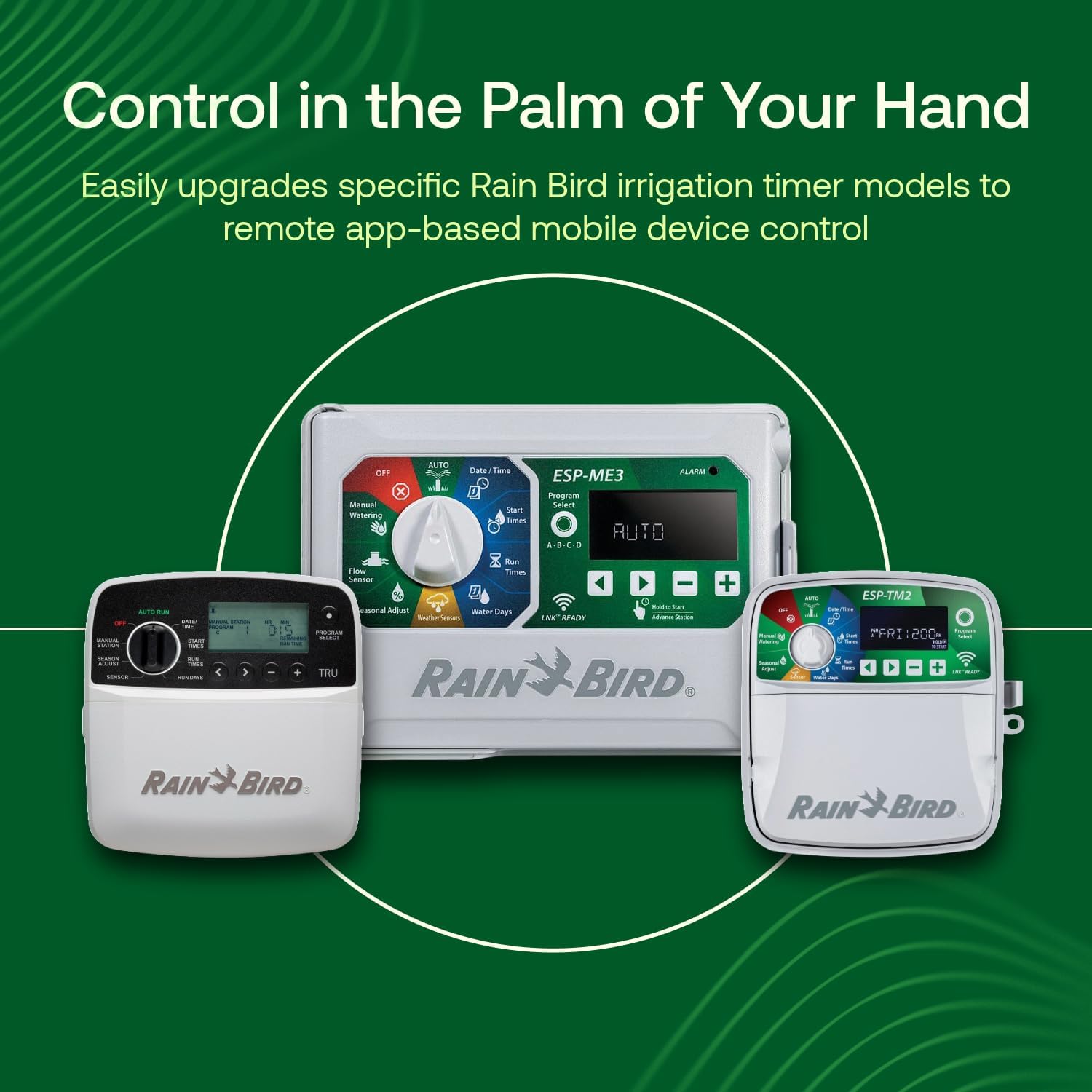
If you’ve got a Rain Bird sprinkler controller — the box wired to your garage wall that tells each irrigation zone when to run — you may have noticed it has no WiFi, no app, and no way to skip a watering cycle without walking outside and turning a dial. That friction is real: every weather-skip you miss is water you pay for and turf you potentially drown. The Rain Bird LNK2 is a small plug-in WiFi module designed to solve exactly that problem by adding smartphone control to compatible Rain Bird controllers without replacing the whole unit. Think of it as a translator that lets your old controller speak to the Rain Bird app on your phone. At roughly $40, it’s one of the highest-leverage purchases in DIY irrigation — if your controller is on the compatibility list. If it isn’t, you’re looking at a full box swap, and that changes the math entirely. This article gives you the framework to make that call confidently.
| EDITOR'S PICKRain-Bird Controller Indoor Out… | Mid-tierRain Bird LNK2 Smart WiFi Modul… | Budget pickRain Bird ARC6 App-Based Indoor… | |
|---|---|---|---|
| Zones | — | — | 6 |
| Compatibility | — | TRU, ESP-TM2, ESP-ME3 | — |
| Modules incl. | 3 | — | — |
| Mount type | Indoor/Outdoor | — | Indoor |
| WaterSense | — | — | ✓ |
| Price | $518.25 | $98.33 | $93.60 |
| See on Amazon → | See on Amazon → | See on Amazon → |
What the LNK2 Actually Does — and What It Doesn’t
The LNK2 is not a controller. It has no scheduling logic of its own. It’s a WiFi bridge: it plugs into a dedicated port on compatible Rain Bird ESP-series controllers and hands off communication to Rain Bird’s cloud platform, which powers the mobile app. Once connected, you get remote schedule edits, rain skip and weather-based adjustments (via local weather station data), and zone-by-zone manual run from anywhere with cell service.
What it doesn’t do: it won’t upgrade your controller’s internal hardware, add zone capacity, or fix a valve relay that’s already failing. The intelligence ceiling of your system stays exactly where your controller sets it. The LNK2 just removes the “walk to the box” tax on every schedule change.
The compatibility gate is the whole story. Rain Bird’s published compatibility documentation lists the following controllers as LNK2-compatible: ESP-RZX, ESP-TM2, ESP-Me (certain firmware versions), ESP-SMT, and the ST8I/ST8II series, among others. Rain Bird’s own product documentation notes that some ESP-Me units manufactured before the LNK2 port was standardized have a different internal pin layout — meaning the module physically seats but does not connect correctly. At least one buyer review pattern across aggregated retail feedback surfaces exactly this scenario: a controller manufactured just before Rain Bird standardized the port required a full unit swap because the pin layout had quietly changed. The takeaway: check the serial number date code against Rain Bird’s current compatibility chart before ordering. The chart is available in Rain Bird’s LNK2 product documentation at rainbird.com — match your model and production year.
The Real Comparison: LNK2 vs. Controller Replacement
Here’s the decision matrix that matters:
By the numbers — upgrade vs. replace
| Scenario | LNK2 path | Replacement path |
|---|---|---|
| Compatible controller, < 8 yrs old | ~$40 + 10 min install | $120–$350 + 1–2 hr wiring |
| Incompatible controller OR > 12 yrs old | Not viable | $120–$350, often worthwhile |
| Controller with relay/valve faults | Adds WiFi but won’t fix faults | Solves software + hardware together |
| Expanding zone count needed | LNK2 doesn’t add zones | New controller may add capacity |
The Irrigation Association’s 2023 smart controller adoption report notes that property owners who add remote access to existing systems report schedule compliance rates significantly higher than those with manual-only controls — the friction reduction is measurable. But that benefit evaporates if your underlying controller is unreliable.
When the LNK2 Is the Right Call
Owners consistently report installs under 10 minutes on compatible units — plug the module into the LNK2 port, open the app, follow the pairing wizard. Reviewers describe the experience as genuinely plug-and-play when the controller is a clean match. For an ESP-TM2 that’s 3–6 years old and running well, spending $40 to add app control is a no-brainer. The controller’s scheduling logic is solid, the hardware is mid-life, and you’re not throwing away anything of value.
The Rain Bird TRU6I — a 6-zone indoor controller frequently paired with the LNK2 — draws consistently positive reviews. Owners describe it as a clean, low-drama successor to older Rain Bird units, with scheduling flexibility that satisfies most residential use cases. The LNK2 + TRU6I pairing is a straightforward upgrade path for anyone moving off a purely manual controller.
When Full Replacement Wins
Three signals push you toward a new controller:
-
Age over 12–14 years. A Rain Bird controller at that vintage is approaching end of expected service life for the transformer, relay contacts, and internal circuitry. The Irrigation Association’s guidance on controller longevity suggests most residential units are designed for 10–15 year service windows. Adding a $40 module to a unit that may fail in 18 months is false economy.
-
Relay or zone faults already present. If you’re seeing zones that won’t activate or activate erratically, the LNK2 cannot fix that. You need hardware, not software.
-
Pin layout incompatibility. As noted above, some pre-standardization ESP-Me units simply won’t work. Don’t force it.
For full replacement at the residential level, the Rain Bird ESP-TM2 with built-in WiFi (where available) and the Rain Bird ARC6 represent two distinct directions worth comparing.
The ARC6 Honest Assessment
The Rain Bird ARC6 is a 6-zone indoor controller with integrated WiFi — no module required. On paper, it competes squarely with the LNK2-upgraded ESP-TM2. In practice, the reviews tell a more divided story than Rain Bird’s marketing suggests.
Reviewers who like the ARC6 point to reliable weather-skip automation and clean scheduling once initial setup is complete. The weather integration is genuinely useful — per EPA WaterSense program documentation, smart controllers with weather-based skip logic can reduce outdoor water use by 15–50% compared to timer-only controllers, and the ARC6 participates in that efficiency tier.
However, across aggregated buyer reviews, a vocal segment of ARC6 owners describe the user interface as deeply frustrating for day-to-day schedule changes. One reviewer’s language — characterizing it as “the worst user interface ever” and stating they would give zero stars if the rating system allowed it — is extreme, but it reflects a real pattern: the ARC6’s app and button-navigation logic appears to have a steep learning curve that doesn’t flatten quickly. For a light-commercial operator managing multiple properties who needs to make quick schedule edits on the fly, that friction has real operational cost.
Decision rule: If you’re managing one residential property and willing to invest time upfront learning the ARC6’s interface, the weather automation payoff is real. If you’re a landscape contractor making daily adjustments across multiple properties, the ARC6’s UI friction is a legitimate dealbreaker — consider the Hunter Pro-HC or Rachio 3 ecosystem instead, where the app UX is consistently praised across large review populations.
ESPME3 Bundle: Large-Property Consideration
The Rain Bird ESPME3 is a modular controller designed for properties with higher zone counts, often bundled with a WiFi module for expanded coverage. Large-property owners praise the ESPME3’s zone capacity and scheduling depth. But there’s a documented failure pattern in aggregated reviews worth flagging: WiFi module dropouts occurring even at close range to the router. This isn’t universal, but it’s consistent enough across multiple independent reviewers to be a real signal rather than outlier noise.
Per University of California ANR’s irrigation scheduling guidance, reliable connectivity is a prerequisite for weather-based skip logic to function correctly — a controller that intermittently loses its cloud connection will revert to its programmed schedule regardless of rainfall, which defeats the purpose of the smart module entirely. If you’re speccing an ESPME3 installation, plan your router placement and signal path before committing. A WiFi extender positioned near the controller eliminates most reported dropout issues.
Frequently Asked Questions
Will the LNK2 work with my specific Rain Bird controller model? The definitive answer comes from Rain Bird’s published LNK2 compatibility documentation — not the product packaging or a retailer’s listing. Cross-reference your controller model and the serial number date code against Rain Bird’s current compatibility chart at rainbird.com. The key risk zone is ESP-Me units manufactured before Rain Bird standardized the LNK2 port; some of these have a changed pin layout that makes the module non-functional even though it physically fits the housing.
What happens if I set a passcode longer than 8 characters in the Rain Bird app? Rain Bird’s app documentation specifies an 8-character maximum for controller passcodes. Reviewers who have exceeded this limit report that the app either truncates the entry silently or produces an error that prevents pairing from completing. Keep passcodes at 8 characters or fewer — this is a hard system constraint, not a suggestion.
Can I add an ESPME3 module to an existing ESP-TM2 setup without rewiring? No — the ESPME3 is a separate controller platform, not a module you add to an ESP-TM2. If you need to expand zone count beyond your ESP-TM2’s capacity, you’re looking at a controller replacement, not a module addition. The LNK2 adds WiFi to the ESP-TM2; it does not add zones or expand the platform’s hardware capability.
Is the ARC6 app actually usable for daily schedule changes, or is the UI a dealbreaker? It depends heavily on your tolerance for interface friction and how frequently you make changes. Owners who set a schedule once and primarily use it for weather-skip automation report reasonable satisfaction. Owners who need frequent manual adjustments — contractors, property managers, anyone running seasonal changes — consistently flag the ARC6’s interface as a productivity problem. If daily or weekly schedule edits are part of your workflow, the ARC6 is a genuine risk. Evaluate before committing.
If my current Rain Bird controller is 14–15 years old, is it worth adding the LNK2, or should I replace the whole unit? Replace the unit. A 14–15-year-old controller is at or past its expected service window. Internal relay contacts, transformers, and circuit boards at that age carry meaningful failure risk. Adding a $40 WiFi module to hardware that may fail within the next irrigation season is poor resource allocation. Budget for a full replacement controller — you’ll get current firmware, a warranty, and built-in or module-ready WiFi without betting on aging hardware.
Buying Decision: The If/Then Framework
If your Rain Bird controller is compatible, under 10 years old, and running without faults: The LNK2 is the clear call. Thirty to forty dollars and ten minutes of install time buys you full app control without touching your wiring. Start there.
If your controller is 10–12 years old, compatible, and fault-free: The LNK2 still makes sense, but price a replacement controller in parallel so you’re not surprised by a mid-season failure.
If your controller is 12+ years old, incompatible, or showing zone/relay faults: Skip the module. Replace the controller. The Rain Bird ESP-TM2 is a proven platform with strong scheduling depth and clean LNK2 integration. The Rain Bird ARC6 is viable for set-and-forget residential use if you can accept its UI learning curve. For multi-property operators or anyone prioritizing app usability, look at the Rachio 3 or Hunter Pro-HC ecosystem before defaulting to the ARC6.
If you’re managing an ESPME3 installation: Solve the WiFi signal path first. A dropped connection is a broken smart controller — the hardware investment only pays off with reliable cloud connectivity.
The $40 LNK2 is one of the best-value upgrades in residential irrigation when the conditions are right. Knowing when those conditions don’t apply is what keeps you from spending $40 on a module and $200 on a controller six weeks later.