August 10, 2026 • Tomás Guerreiro • 11 min reading time • Specs verified June 18, 2026
Rain Bird 32SA vs. Rain Bird 5000 Rotor: Which Gear-Drive Head Fits Your Turf Zone?
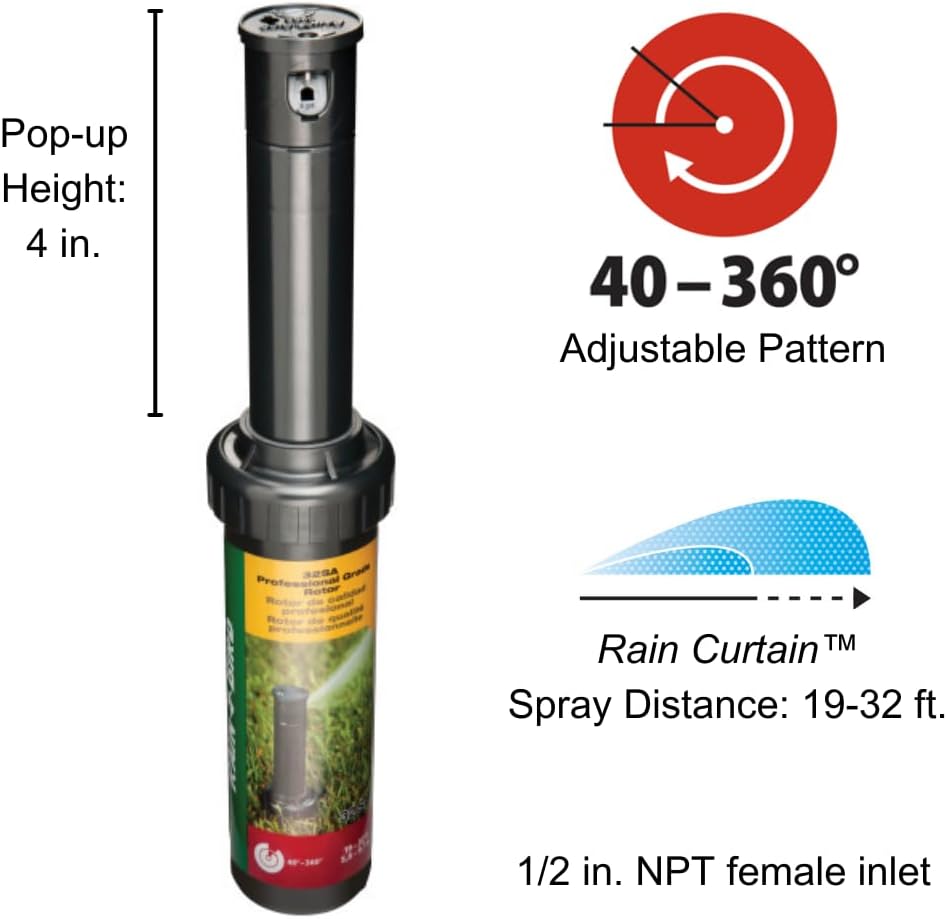
If you’ve been doing irrigation work long enough to spec a multi-zone system, you already know that gear-drive rotors — sprinkler heads that use a small internal gear mechanism to sweep water slowly across a turf area rather than spinning freely or spraying in a fixed pattern — are the workhorse of any lawn zone over about 15 feet wide. The sweep motion lets you use far less water per pass and still hit the full radius. Rain Bird makes two rotors that come up constantly in residential and light-commercial specs: the 32SA and the 5000 series. From the outside they look almost identical. Pull them apart on paper, and the differences in radius range, nozzle flexibility, and total cost of ownership tell a cleaner story about which one belongs on your next job. This article gives you the comparison framework, the math, and a straight decision rule.
Understanding the Core Specs: Where 32SA and 5000 Part Ways
Let’s put the published numbers side by side before getting into application logic.
By the numbers (manufacturer-rated specs):
| Spec | Rain Bird 32SA | Rain Bird 5000 Series |
|---|---|---|
| Radius range | 25–37 ft | 25–50 ft |
| Arc adjustment | 40°–360° | 40°–360° |
| Flow range (GPM) | ~1.0–3.5 GPM | ~0.4–4.0 GPM |
| Nozzle system | Fixed factory nozzles | Interchangeable nozzle tree |
| Pop-up height | 4 in | 4 in |
Head Profile: Rain Bird 32SA
Per Rain Bird’s 32SA Series Rotor Technical Spec Sheet, the head is designed for residential medium-to-large turf areas where a consistent, limited radius range is acceptable. Think a standard suburban backyard where 25 to 37 feet covers every corner without overshooting into beds or hardscape. The arc adjustment range runs from 40° to 360°, and the fixed nozzle system means every head on a zone behaves predictably from day one — no nozzle-swap decisions to make at install time.
The practical upside of that simplicity is real. For high-volume installs where you’re dropping ten or more heads in a day, a workflow that requires zero nozzle selection decisions per head has genuine time value. The fixed nozzle also removes one variable from troubleshooting if a head underperforms later. The tradeoff is commitment: if your zone’s GPM budget shifts after install — because a client added a drip manifold downstream, or field pressure runs lower than the gauge showed — you can’t respec the head without replacing hardware.
Rain
$11.36
In stock on Amazon
Check price on AmazonHead Profile: Rain Bird 5000 Series
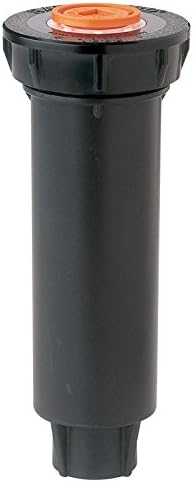
The 5000’s published spec sheet extends the radius ceiling out to 50 feet, which opens up a different class of site: athletic turf margins, larger commercial lawn panels, and wide-open residential zones where the 32SA simply cannot reach. That wider radius ceiling also means the 5000 can run lower-precipitation nozzles — a meaningful variable when you’re managing a water budget in a drought-restricted municipality.
The University of California Agriculture and Natural Resources publication Landscape Irrigation Scheduling and Water Management (available through ucanr.edu) emphasizes matched precipitation rate across zones as a foundational scheduling principle. The 5000’s interchangeable nozzle tree is the mechanical mechanism that makes matched precipitation rate achievable across heads of varying radius in the same zone — something the fixed-nozzle 32SA cannot replicate without head replacement.
One field note worth flagging for first-time buyers: the nozzles arrive somewhat loosely packaged inside the box. They are not defective. They simply are not individually bagged or labeled with ceremony. Lay them out and identify each by its stamped flow code before you start the install — it saves confusion mid-trench.
Rain
$29.15
In stock on Amazon
Check price on AmazonHead Profile: Comparison at the Zone Level
Putting both heads against each other at the zone-design level makes the decision cleaner than comparing spec-sheet rows in isolation.
The arc adjustment range is identical on both heads — 40° to 360° — so neither has an advantage in lot-shape flexibility. Pop-up height is the same at 4 inches on both, meaning neither is preferable for tall-turf situations. The meaningful divergence is radius ceiling, GPM floor, and nozzle replaceability.
For zones under 40 feet in any dimension, the 32SA’s ceiling is adequate and its simplicity is an asset. For zones that exceed 40 feet, or for partial-zone replacements where you need to match existing head output without buying all-new hardware, the 5000’s nozzle tree is not a marketing feature — it is the engineering solution to a real field problem. The Irrigation Association’s Best Practices for Residential Rotor Head Selection (irrigation.org) recommends that installers confirm matched precipitation rates across all heads before finalizing zone valve schedules, and the 5000’s interchangeable nozzles are the most straightforward path to that confirmation in mixed-radius zones.
Rain
$37.08
In stock on Amazon
Check price on AmazonThe Nozzle System in Practice: GPM Math and Field Flexibility
The nozzle decision is where intermediate practitioners most often make a spec mistake, and it’s worth slowing down on.
For the 32SA: The fixed nozzle system simplifies install and reduces variables, but it also means your per-head GPM is set at the factory. Before you spec the 32SA, calculate your zone’s available GPM and confirm that the 32SA’s published flow range — approximately 1.0 to 3.5 GPM depending on nozzle size and operating pressure — lands within your budget at the number of heads your layout requires. Rain Bird’s 32SA Series Technical Spec Sheet includes flow tables at multiple operating pressures; use those numbers, not nominal pressure estimates.
For the 5000: Start with your static pressure measured at the valve with a pressure gauge. Subtract estimated friction loss for the zone’s pipe run — the Irrigation Association’s residential rotor guidance recommends working with dynamic (operating) pressure, not static, for this calculation. Divide remaining available GPM by the number of heads on the zone. That per-head flow number is your nozzle selector. Rain Bird’s 5000 Series nozzle flow tables, published in the 5000 Series Technical Spec Sheet, list GPM at multiple operating pressures for each nozzle code, so you can confirm the match at your actual operating pressure before committing.
Can you mix 32SA and 5000 heads on the same zone? Technically possible in a retrofit situation, but it requires careful nozzle matching to keep precipitation rates even. Because the 32SA uses fixed nozzles and the 5000 uses interchangeable nozzles, you’d need to select a 5000 nozzle that outputs the same GPM and covers a matching radius as the 32SA heads already in place. If you cannot confirm a matched nozzle exists for your specific layout, the cleaner move is to standardize the zone on one head type. Uneven precipitation rates create dry spots and wet spots that no controller schedule can fully correct.
Longevity, Retraction, and Total Cost of Ownership
Retraction quality — how cleanly and reliably the pop-up stem drops back into the body after the zone shuts off — is one of the most practically consequential specs on any gear-drive rotor, and it rarely appears on a spec sheet. Family Handyman’s Sprinkler System Troubleshooting Guide (familyhandyman.com) identifies incomplete retraction as one of the most common field complaints on budget gear-drive heads, typically traced to a weak return spring or poor stem tolerances. A stem that doesn’t fully retract becomes a mowing hazard and a debris-intake point that accelerates internal wear.
The 32SA has a consistent field reputation for retraction quality that outperforms generic competitors at similar price points. That retraction consistency is a total-cost-of-ownership factor: heads that retract cleanly last longer and generate fewer callbacks than heads that sit proud of grade after every cycle.
Service life expectations: Owner feedback on the 32SA clusters around roughly five years of typical residential use as a realistic service life. That is not a criticism — it is a useful planning benchmark for property management budgets. Knowing the expected replacement cycle lets you build it into a maintenance contract rather than treating head failure as an unplanned expense.
The 5000 series has a longer field history and a similarly strong reliability record under normal operating conditions. Practitioners who’ve mixed 5000 heads into existing zones — including partial-zone rehabs replacing heads from other manufacturers — consistently report that coverage matches existing heads without requiring nozzle or arc re-tuning after install. That behavioral consistency across nozzle swaps has earned the 5000 a “trusted fallback” position in the market: when something fails and a client needs a fix fast, the 5000 is the head that reduces callbacks because its output is predictable before the first test cycle.
Both heads will underperform their rated service life if they run at pressures outside their rated range, take regular mowing strikes, or operate in zones with dirty water supply that accelerates internal wear.
Zone Logic: What Neither Head Should Be Doing
A note that applies to both heads before the decision framework: neither rotor belongs on the same zone as drip lines, shrub beds, or slopes.
This Old House’s How to Install and Adjust Sprinkler Heads (thisoldhouse.com) and the Irrigation Association’s residential best practices both reinforce that turf rotors and drip emitters operate at fundamentally different pressure and flow requirements. Mixing them forces a compromise on both zones — the rotors are chronically under-pressured or the drip emitters are chronically over-pressured, and the controller schedule cannot resolve physics. If you’re adding either of these heads to an existing system, confirm that the zone they’re joining is turf-only and matched for the pressure range these heads require.
Application Decision Framework
Here is the clean decision rule this comparison points toward:
Spec the Rain Bird 32SA when: your turf zone is under 40 feet in any dimension, you want the simplest and most repeatable install workflow, and your GPM budget is fixed before the install begins. The single-screwdriver adjustment process is fast, the fixed nozzle system reduces installation variables, and the retraction quality outperforms generic alternatives at this price point.
Spec the Rain Bird 5000 Series when: your zone exceeds 40 feet in any dimension, you’re doing a partial-zone replacement that requires nozzle-matching flexibility, your GPM budget may require mid-project adjustment, or you’re working on a light-commercial application where future property managers may need to swap nozzles without calling a contractor. The nozzle tree is a real engineering advantage that saves revisits.
Frequently Asked Questions
What screwdriver do I need to adjust the 32SA arc and distance? A standard flat-head (slotted) screwdriver fits both the arc and radius adjustment screws on the 32SA. No proprietary tool is required — a medium flat-head in your kit covers everything.
Does the 5000 require a special adjustment tool? Arc adjustment on the 5000 uses Rain Bird’s included plastic arc-adjustment tool, which ships with the head. For radius reduction, a flat-head screwdriver fits the radius adjustment screw in the nozzle. If you lose the plastic arc tool, a thin-bladed flat screwdriver can substitute in a pinch, and Rain Bird sells replacement tools separately.
Will the Rain Bird 5000 fit the same swing-joint riser as my old heads? The 5000 uses Rain Bird’s standard ½-inch female NPT thread inlet, which is the most common spec in residential swing-joint risers. In most cases it drops straight in. If you’re replacing heads from a non-Rain Bird brand, confirm the thread spec on your existing risers before ordering — some older or off-brand systems used non-standard fittings.
How do I select the right nozzle from the 5000’s nozzle tree? Calculate your zone’s available GPM, divide by the number of heads on the zone, and match that per-head flow number to the nozzle codes stamped on the nozzle tree. Cross-reference against Rain Bird’s published nozzle flow tables in the 5000 Series Technical Spec Sheet at your actual operating pressure — not nominal pressure — before finalizing the selection.
Do both heads work on slopes? Neither the 32SA nor the 5000 is the preferred choice for sloped turf zones without a matched precipitation rate strategy and careful scheduling. The Irrigation Association’s residential best practices recommend cycle-and-soak scheduling on slopes to prevent runoff, regardless of which rotor head is installed. Consult the zone’s slope percentage and soil infiltration rate before scheduling.
Buying Decision Summary
For a standard residential turf zone under 40 feet: the Rain Bird 32SA is the straightforward, reliable choice. Its retraction quality outperforms generic competitors, the single-screwdriver adjustment workflow is fast, and the fixed nozzle system reduces installation variables for high-volume work.
For any zone over 40 feet, any partial-zone replacement requiring nozzle matching, or any light-commercial application where future flexibility matters: the Rain Bird 5000 Series is the correct spec. The interchangeable nozzle tree is worth the modest price premium, and the 5000’s field reputation for behavioral consistency across nozzle swaps is well-earned.
Both heads are available through irrigation specialty distributors. Measure your GPM and operating pressure before you trench anything, confirm your zone is turf-only before you set either head, and the install will answer the zone logic questions before they become callbacks.