September 4, 2026 • Tomás Guerreiro • 10 min reading time • Specs verified June 18, 2026
Rain Bird TRU6I vs. Rain Bird ARC6: Choosing the Right New-Generation Rain Bird Controller
If you’ve ever replaced a 20-year-old sprinkler timer — the kind mounted in your garage with a twist dial and no display — you know how disorienting it can be to suddenly face a wall of modern options. An irrigation controller (also called a timer or clock) is the brain of your sprinkler system: it tells each zone (a group of heads wired together and controlled by a single valve) when to run and for how long. Get the controller wrong and you’re either watering manually for a season or fighting an app that makes you feel like you failed a software certification. Rain Bird’s two current standalone controllers — the TRU6I and the ARC6 — are aimed squarely at the upgrade market, but they serve meaningfully different buyers. This article lays out exactly who should buy which one, with tradeoffs named plainly and the math shown where it matters.
What Each Controller Actually Is
Before comparing specs, it’s worth anchoring on what Rain Bird is positioning each unit to do.
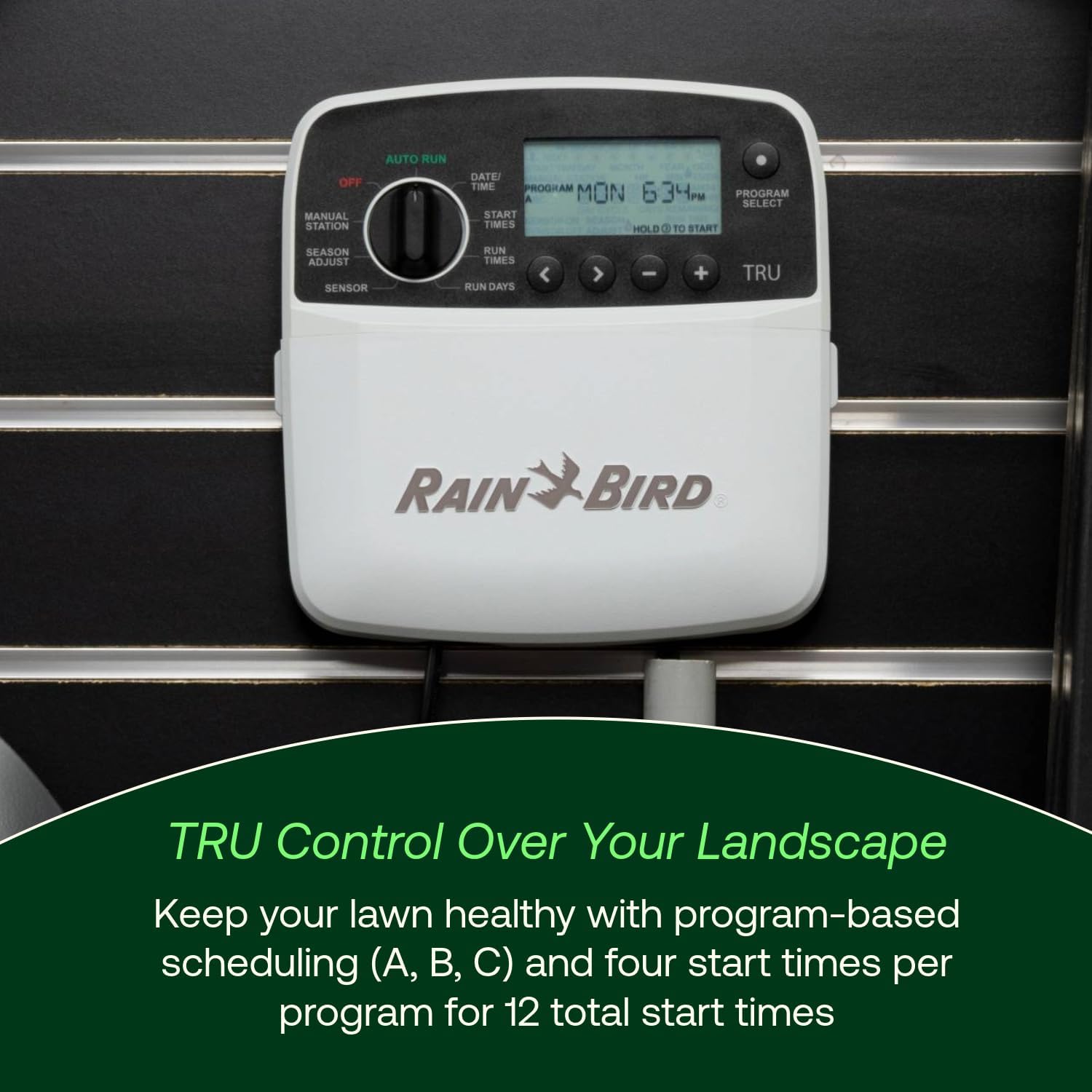
The Rain Bird TRU6I is a six-zone indoor/outdoor controller designed to be a clean mechanical replacement for older Rain Bird rotary and dial-type controllers — particularly the legacy ESP and ESP-Me series that populated residential and light-commercial systems from the mid-1990s through the early 2010s. It is a WiFi-ready controller, meaning it has an internal slot that accepts an optional add-on WiFi module (the Rain Bird LNK2) but does not include WiFi connectivity out of the box. Without the LNK2, it runs as a conventional timer with multiple program schedules. With the LNK2 installed, it becomes a smart controller.
The Rain Bird ARC6 is a six-zone controller with app-native WiFi built in — no separate module needed. It is aimed at the homeowner who wants to skip manual scheduling entirely and manage the system from a phone from day one. On paper, this sounds like the obvious winner. In practice, the owner experience is more complicated.
Understanding that difference — WiFi-ready versus app-native — is the single most useful frame for this comparison.
By the Numbers
| Feature | TRU6I | ARC6 |
|---|---|---|
| Zones (base) | 6 | 6 |
| WiFi included | No (LNK2 add-on) | Yes (built-in) |
| Programs | 4 independent | 3 independent |
| Indoor/Outdoor rated | Both | Indoor only |
| Backplate compatibility | Fits most legacy Rain Bird ESP footprints | New footprint |
| Weather-skip subscription required | No | No |
Head-to-Head: Three Buyer Profiles Compared
The Legacy Replacement Buyer
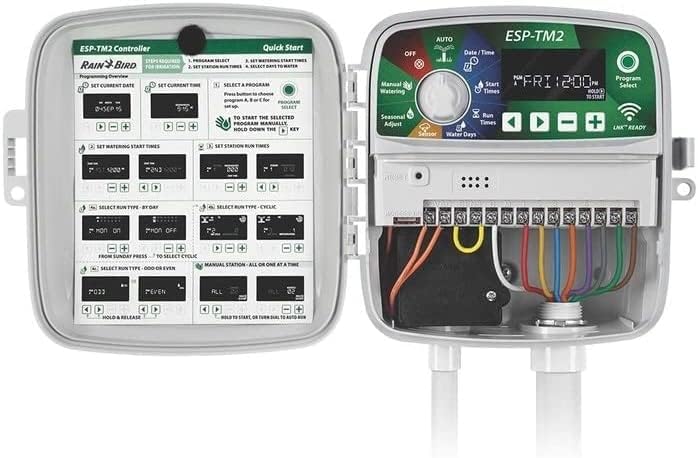
This is the most common upgrade scenario: an existing Rain Bird ESP, ESP-24, or ESP-Me controller is dying or already dead, the backplate is anchored to the wall, and six wires are labeled in someone else’s handwriting. The buyer wants the fastest, lowest-risk swap possible.
TRU6I advantage is decisive here. Per Rain Bird Corporation’s TRU6I Indoor/Outdoor Controller Installation and Operation Manual (2024 edition), the TRU6I was explicitly engineered to maintain dimensional compatibility with legacy Rain Bird ESP-series backplates. Multiple owners who replaced ESP-24 and ESP-Me controllers report that the mounting holes aligned with existing wall anchors, the same wire lengths reached the terminal strip without re-stripping, and the whole swap took under 30 minutes. That is not a trivial advantage. A clean drop-in replacement eliminates the single most anxiety-inducing part of a controller swap — the moment where you’re holding six unlabeled wires and hoping your phone’s camera photo was good enough.
The ARC6 ships with a new footprint. In a legacy-replacement scenario, that means re-drilling anchors and managing wire slack — minor work, but avoidable work.
Rain-Bird
$216.85
In stock on Amazon
Check price on AmazonThe New-Installation Buyer
When you’re doing a full controller re-mount on fresh drywall with new wire runs, the backplate compatibility argument disappears. Both units are physically viable, and the decision shifts entirely to how you want to manage connectivity.
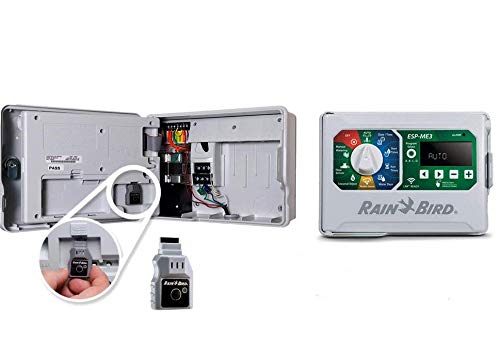
The TRU6I + LNK2 path gives you a modular setup: the controller works fully without WiFi, and you add the LNK2 module when you’re ready. Owners consistently describe the LNK2 install as a 10-minute process. The Rain Bird app experience with the LNK2 draws strong reviews, with users specifically calling out how reliably the module joins the network and how clean the schedule interface is compared to competitors. The tradeoff is that you’re purchasing two items rather than one.
The ARC6 path consolidates hardware: WiFi is built in, one box, lower initial cost. Installation draws nearly universal praise in owner reviews — the physical setup is well-documented and the terminal labeling is clear enough that owners with no prior irrigation experience report getting wired up without confusion. The friction starts after that. Owner reviews of the ARC6 split sharply at the app layer, with recurring complaints about WiFi pairing difficulties and schedules that don’t sync reliably between the physical controller and the app. This is not a fringe complaint — it appears across multiple independent review sources.
The Irrigation Association’s Smart Controller Technology Report (2024) notes broadly that app-native controllers with tightly coupled hardware and proprietary cloud backends carry higher user-experience variance than modular systems — a pattern consistent with the ARC6 review distribution.
Rain
$58.99
In stock on Amazon
Check price on AmazonThe Multi-Zone Property Manager
For a property with turf, drip beds, and a slope zone running on meaningfully different schedules — or for a contractor handing off a system to a client — program count and reliability matter more than app elegance.
The TRU6I supports four independent programs (A, B, C, D), each with up to three start times and individual run durations per zone, per Rain Bird Corporation’s TRU6I Installation and Operation Manual (2024 edition). Four programs is the right working number for a layered irrigation system. Owners across aggregated reviews consistently identify the multi-program flexibility as the standout feature — and note that it works correctly out of the box without needing a firmware update or app connection.
The ARC6 supports three programs. For a simple residential system with a single irrigation type, three is sufficient. For anything with turf on a different schedule than a drip bed, or a slope zone running shorter cycles more frequently to prevent runoff, three programs becomes a constraint.
University of California Agriculture and Natural Resources Cooperative Extension, in their landscape irrigation scheduling publication (Landscape Irrigation Scheduling and Water Management, publication 8446, available at ucanr.edu), emphasizes that separate scheduling for different hydrozones — areas with distinct water needs — is foundational to water-efficient irrigation. A controller that limits you to three programs limits your ability to implement that guidance correctly.
Additionally, the TRU6I carries an outdoor installation rating. The ARC6 is indoor-only per Rain Bird’s published ARC6 Series WiFi Controller Product Specification Sheet (2025). For a controller installed in an unprotected garage, an outdoor enclosure, or a pedestal mount — common in older residential systems — the TRU6I is the only compliant choice of the two.
Rain-Bird
$259.95
In stock on Amazon
Check price on AmazonThe WiFi Module Decision: LNK2 Versus Built-In
One of the most common buyer questions around this comparison is whether the LNK2 module on the TRU6I effectively neutralizes the ARC6’s built-in WiFi advantage. For most buyers, the honest answer is: yes, largely.
The LNK2 consistently earns strong reviews. Owners report quick network pairing, reliable app control, and a Rain Bird app experience that stands in clear contrast to what ARC6 app users are describing. The cost of adding the LNK2 to a TRU6I purchase narrows the ARC6’s price advantage considerably, but the total-cost math typically still favors the ARC6 by a small margin — and for some buyers that margin is real.
One hardware issue worth naming explicitly: a known pairing failure exists on the Rain Bird ESP-ME3 WiFi module — separate from the LNK2 — where the module appears to join a network on the controller display but the app cannot control zones. If you encounter this failure pattern on any Rain Bird WiFi module, the documented resolution is to fully delete the device from the Rain Bird app (not just log out — delete the device entry entirely), factory-reset the module using the button sequence in the installation manual, and re-pair from scratch as if it’s a new device. Cycling controller power does not fix this. The University of California Agriculture and Natural Resources Cooperative Extension’s landscape irrigation management guidance (publication 8446, ucanr.edu) notes that firmware-related connectivity failures in smart controllers are almost always resolved at the network-pairing layer rather than the hardware layer — a useful framing if you’re troubleshooting before concluding you have a defective unit.
Decision Framework: If X, Then Y
Here is the direct version:
- Replacing a legacy Rain Bird ESP controller with an existing backplate in the wall → TRU6I. The dimensional compatibility alone justifies it. Add the LNK2 if you want smart features.
- New installation, fresh wire runs, no existing backplate → Either unit is physically viable. Choose based on how you want to manage WiFi: modular (TRU6I + LNK2) or integrated (ARC6).
- Need four independent programs for a multi-zone system with turf, drip, and slope zones → TRU6I. The ARC6 gives you three.
- Controller will be installed outdoors or in an unprotected garage → TRU6I. It carries an outdoor installation rating. The ARC6 is indoor-only per published spec.
- System will be handed off to a client or a less technical user → TRU6I + LNK2. The ARC6’s app friction is a documented pattern; you will get the support call.
- Budget is the binding constraint and you want WiFi without a second purchase → ARC6, but go in knowing that app troubleshooting may be part of the ownership experience.
Frequently Asked Questions
Will the TRU6I mounting holes line up with my existing ESP controller backplate? In the majority of cases, yes. Owners replacing ESP-24, ESP-Me, and similar legacy Rain Bird controllers consistently report that the TRU6I mounts directly to existing wall anchors without re-drilling. Always photograph your existing backplate before removal so you have a reference if a hole doesn’t align — but expect a clean fit in most residential installations.
What is the difference between WiFi-ready and app-native on Rain Bird controllers? WiFi-ready means the controller has a hardware slot for an optional WiFi module (like the LNK2) but ships without one. You buy and install the module separately. App-native means WiFi is built into the controller itself — no additional hardware required, but the experience is tightly tied to that specific app and firmware ecosystem.
Does the ARC6 require a subscription for weather-skip features? As of mid-2026, no. Per Rain Bird’s published ARC6 Series WiFi Controller Product Specification Sheet (2025), basic weather-based skip scheduling on the ARC6 does not require a subscription. This may change in future firmware or app updates, so verify Rain Bird’s current terms before purchasing if this is a deciding factor.
Can I add an LNK2 module to an ARC6? No. The ARC6 has WiFi built in and does not have a module expansion slot. The LNK2 is the upgrade path for the TRU6I only. Do not purchase both expecting them to stack — they are not compatible in that way.
What should I do if my Rain Bird WiFi module shows as connected on the controller but the app won’t control zones? This is a documented failure pattern. Fully remove the controller from the Rain Bird app — delete the device entry, not just log out. Then factory-reset the WiFi module using the button sequence in the installation manual. Re-pair from scratch as if it’s a new device. In most documented cases, this resolves the disconnect between the controller’s local network status and the app’s cloud connection. If the problem persists after two full re-pair attempts, contact Rain Bird support with your module firmware version, as this pattern has been associated with specific firmware builds.