September 9, 2026 • Tomás Guerreiro • 11 min reading time • Specs verified June 18, 2026
Pop-Up Rotor Head Replacement Guide: Rain Bird 32SA, Rain Bird 5000, and the Impact Sprinkler That Still Earns Its Place
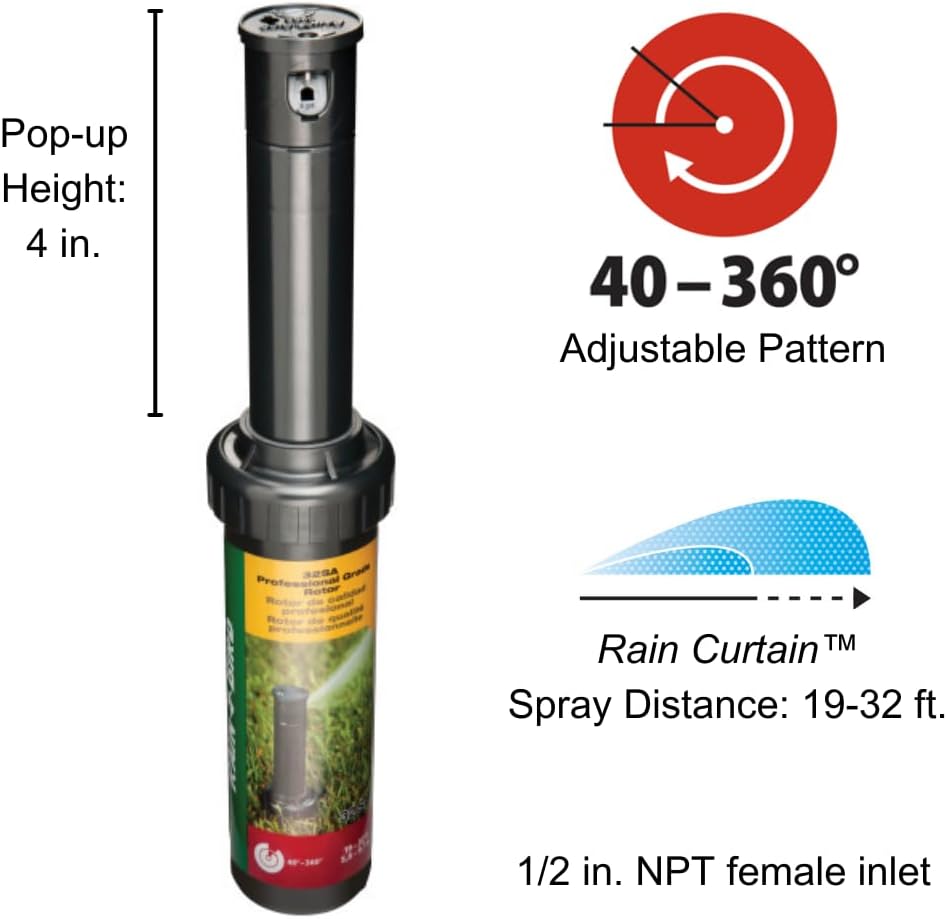
A pop-up rotor head is the sprinkler body buried flush with your lawn that rises out of the ground when the zone pressurizes, rotates to sweep an arc of water across the turf, then retracts when the valve closes. They’re the workhorses of any residential or light-commercial turf zone — and like any mechanical component that cycles hundreds of times a season, they wear out. Seals degrade, nozzles clog with mineral deposits, and the internal turbine that drives rotation grinds down over years of grit and hard water. Knowing when to replace rather than repair, and which head to spec for your specific zone geometry, pressure budget, and water source, is exactly the kind of decision that separates a system that performs from one that leaves dry strips and soggy corners.
This guide focuses on three Rain Bird products that together cover the overwhelming majority of residential and light-commercial replacement scenarios: the Rain Bird 32SA (a compact, efficient rotor built for tight spaces and moderate pressure), the Rain Bird 5000 (the workhorse mid-range rotor with one of the deepest nozzle libraries available), and the Rain Bird P5R (a plastic impact sprinkler that occupies a surprisingly strong niche for well-water and low-pressure situations). By the end, you’ll have a clear decision framework for which head goes where — and why.
| EDITOR'S PICKRain Bird 32SA/4PKS Simple Adju… | Mid-tierRain Bird 1800 Series Pop-Up Sp… | Budget pickRain Bird 32SA Simple Adjust Ge… | |
|---|---|---|---|
| Type | Gear drive rotor | Pop-up sprinkler | Gear drive rotor |
| Spray distance | 19'–32' | — | 19'–32' |
| Adjustable arc | 40°–360° | — | 40°–360° |
| Pop-up height | — | 4" | — |
| Pack count | 4 | 10 | 1 |
| Price | $37.08 | $29.15 | $11.36 |
| See on Amazon → | See on Amazon → | See on Amazon → |
Your GPM and PSI Budget Come First — Always
Before any product comparison matters, you need two numbers: your static water pressure (measured in PSI — pounds per square inch, the force behind your water supply) and your flow rate (measured in GPM — gallons per minute, the volume your supply line can deliver). Without these, you’re guessing at nozzle selection and zone counts.
The Irrigation Association’s best management practices document is direct on this point: zone design must stay within the hydraulic capacity of the supply line, or you’ll get precipitation rate mismatches — uneven water distribution that creates dry patches even when run time looks correct. CSU Extension’s irrigation maintenance fact sheet reinforces that pressure-regulated heads are increasingly important as municipal supply pressures fluctuate seasonally.
Quick measurement baseline:
- Measure static PSI at an outdoor hose bib with a simple gauge ($8–$12 at any hardware supplier).
- Run a bucket flow test: time how long it takes to fill a 5-gallon bucket at that bib. Divide 5 by seconds, multiply by 60 → your GPM.
- Most residential systems run 40–80 PSI static; rotor heads typically operate best at 30–45 PSI at the head (after pipe friction losses).
The Rain Bird 5000 is rated for 25–65 PSI operating range. The 32SA is rated 25–55 PSI. The P5R impact head operates effectively as low as 15–20 PSI — and that low-pressure performance is the whole reason it belongs in this conversation.
Rain Bird 32SA vs. Rain Bird 5000: Where Each Head Wins
Both the 32SA and 5000 are gear-driven pop-up rotors — they use a water-powered turbine and gear train to rotate the head smoothly. But they’re engineered for different coverage scenarios.
Rain Bird 32SA: The Maintenance-Minded Pro’s Compact Rotor
The 32SA is built for smaller turf areas and tighter zone geometries. Published specs put its radius range at approximately 13–24 feet depending on nozzle selection and operating pressure. Owners in aggregated reviews consistently frame it in practical maintenance language: one reviewer explicitly describes replacing heads at roughly the five-year mark as planned maintenance, not product failure. That’s the right mindset. At five years of twice-weekly cycling across a full irrigation season, a rotor head has executed thousands of mechanical cycles. Treating replacement as a scheduled line item — not a warranty complaint — keeps your system performing at spec.
The arc adjustment on the 32SA is a genuine field advantage. As multiple owners note in long-run reviews, adjusting both arc width and radius requires nothing more than a small flathead screwdriver — the adjustment socket is accessible at the top of the retracted head. No proprietary tool, no fumbling with a separate key while you’re kneeling in a muddy bed. For a contractor running maintenance across multiple properties, that matters.
32SA best fits:
- Zones under 25-foot radius requirements
- Systems running 25–55 PSI at the head
- Planned five-year replacement cycles as a maintenance budget line
Rain Bird 5000: The Nozzle-Tree Workhorse for Standard Turf Zones
The Rain Bird 5000 series covers a wider radius range — published specs show approximately 25–50 feet depending on nozzle and pressure — making it the correct choice for standard residential lawns, park strips, and commercial turf areas where the 32SA simply can’t throw far enough.
Where the 5000 pulls ahead operationally is its nozzle flexibility. The nozzle-tree bundle version includes a set of interchangeable nozzles that let you dial in the throw distance to match your actual zone geometry rather than accepting a fixed radius. Owners who use this bundle consistently call out the included adjustment tool as genuinely useful — not marketing filler. Per manufacturer documentation, the 5000 also supports matched precipitation rate nozzles, which the UC ANR landscape irrigation scheduling publication identifies as one of the highest-impact choices for water efficiency in mixed-geometry zones.
One installation note that Rain Bird’s product documentation does not surface prominently: if you’re mounting a 5000 on an above-ground riser stake for supplemental or temporary zones (a legitimate and underserved use case that reviewers describe as working well), you will need a separate ½-inch to ¾-inch fitting. It is not included, and the product literature doesn’t flag it. Buy it before you’re on-site.
By the Numbers: 32SA vs. 5000 at a Glance
| Rain Bird 32SA | Rain Bird 5000 | |
|---|---|---|
| Radius range | ~13–24 ft | ~25–50 ft |
| Operating PSI | 25–55 PSI | 25–65 PSI |
| Arc adjustment | Flathead screwdriver | Included adjustment tool |
| Nozzle options | Fixed + limited interchangeable | Full nozzle-tree library |
| Best use | Tight zones, smaller turf | Standard to large turf zones |
The Rain Bird P5R: Why a Plastic Impact Sprinkler Still Has a Real Job in 2026
The impact sprinkler is the older technology here — instead of a gear-driven turbine, it uses a weighted deflector arm that repeatedly strikes the water stream to rotate the head in small increments. Most irrigation designers moved to gear-driven rotors years ago for quieter, smoother operation. But the P5R earns its place in specific conditions where gear-driven heads underperform.
Well water with high iron content is the clearest case. Aggregated owner reviews consistently surface this: one reviewer credits the P5R as the only head that reliably survives iron-ore well water long-term. The internal mechanism of a gear-driven rotor — small plastic gears, tight turbine tolerances — is vulnerable to iron oxidation and mineral precipitation that clogs the turbine pathway. The P5R’s simpler impact mechanism has fewer tight-tolerance internal surfaces to foul.
Low-pressure systems are the second case. Multiple reviewers note the P5R outperforms brass-bodied impact sprinklers and some gear-driven heads at low operating pressure, despite its modest price point. At 15–20 PSI where a gear-driven rotor may stall or rotate erratically, the impact mechanism continues to function. If your well or municipal supply delivers under 30 PSI at the head after friction losses, this matters.
Is the P5R an in-ground pop-up head? This is a common buyer confusion worth addressing directly: the P5R is designed as an above-ground sprinkler on a riser, not as a pop-up body. It does not have a retractable pop-up stem. It can be installed on a swing-pipe riser in an in-ground application, but the head itself remains above grade — making it vulnerable to mower strike in maintained turf. Its proper habitat is garden beds, orchards, nursery rows, utility areas, and any zone where above-grade installation is acceptable. For maintained turf with regular mowing, it’s not the right tool.
Can You Mix 32SA and 5000 Heads on the Same Zone?
The short answer is: no, and you shouldn’t want to. The longer answer is the more useful one.
Mixing rotor heads with different precipitation rates on the same zone creates matched precipitation rate (MPR) violations — essentially, one head type puts down water faster or slower per square foot than the other, so any run time that waters one correctly over- or under-waters the other. The EPA WaterSense program’s labeled products documentation identifies MPR mismatches as one of the leading causes of landscape overwatering.
The 32SA and 5000 are designed for different radius ranges, which means their nozzle flow rates are calibrated for different coverage areas. Mixing them on the same zone means you’re almost certainly running mismatched precipitation rates. Run them on separate zones, sized to their respective radius requirements. This is also why your zone logic matters as much as head selection: the Irrigation Association’s best management practices document is explicit that heads covering different distances should never share a zone valve.
Frequently Asked Questions
What is the practical radius difference between the Rain Bird 32SA and the Rain Bird 5000 with its full nozzle tree?
Based on published manufacturer specifications, the 32SA tops out at approximately 24 feet of radius under ideal pressure conditions, while the 5000 with its full nozzle tree extends to approximately 50 feet. In practice, most residential systems run at the lower end of the 5000’s range (30–40 feet) due to pressure losses through supply lines and elevation changes. If your zone dimensions require more than 24 feet of throw, the 5000 is the correct head.
Can I mix 32SA and 5000 heads on the same zone without creating dry patches?
No. Because the two heads are engineered for different radius ranges, their nozzle flow rates produce different precipitation rates per square foot. Running them on the same zone virtually guarantees dry patches in high-radius areas or soggy conditions in short-radius areas regardless of how you program the run time. Keep them on separate zones.
What fitting do I need to mount a Rain Bird 5000 on an above-ground riser stake?
A ½-inch to ¾-inch threaded adapter fitting — this is a standard irrigation fitting available at any irrigation supply house, but it is not included with the 5000 and is not called out in Rain Bird’s standard product documentation. If you’re spec’ing an above-ground supplemental or temporary zone deployment, add this fitting to your materials list before going to the field.
How do I adjust the arc on a 32SA without a special tool?
You don’t need a special tool. The 32SA’s arc adjustment is designed for a standard small flathead screwdriver inserted into the adjustment socket at the top of the retracted head. Rotate clockwise to decrease arc, counterclockwise to increase. Radius adjustment (nozzle throttle) uses the same screwdriver on the radius reduction screw at the nozzle face. Owners in long-run reviews consistently confirm this is one of the 32SA’s practical field advantages over heads requiring proprietary keys.
Is the Rain Bird P5R plastic impact sprinkler suitable for an in-ground pop-up installation or is it above-ground only?
The P5R is above-ground only — it has no retractable pop-up body. It can be installed on a swing-pipe riser in an in-ground lateral line application, but the head itself will sit above grade and is vulnerable to mower damage in maintained turf. Its correct applications are beds, orchard rows, nursery zones, utility areas, and any situation where the head can safely remain above grade between irrigation cycles.
Buying Decision: If X, Then Y
Here’s the decision framework for the three scenarios this guide covers:
If your zone radius is under 24 feet, your system runs 25–55 PSI, and you want a head you’ll replace on a planned five-year cycle: spec the Rain Bird 32SA. Its compact footprint, flathead-adjustable arc, and strong owner satisfaction pattern across aggregated reviews make it the right tool for smaller turf zones.
If your zone radius runs 25–50 feet and you need nozzle flexibility to match your actual throw geometry: spec the Rain Bird 5000 with the nozzle-tree bundle. Budget the separate ½-to-¾-inch fitting if you’re doing any above-ground riser deployment. Run it on its own zone — never mixed with 32SA heads.
If you’re on well water with high iron content, or your system pressure at the head falls below 25 PSI: the Rain Bird P5R impact sprinkler is the defensible choice. Its simpler mechanism survives mineral-fouling conditions that clog gear-driven rotors, and owners in low-pressure situations consistently report reliable performance where other heads stall. Deploy it above grade on a riser — not as a pop-up in maintained turf.
In all three cases, measure your PSI and GPM first. Everything else in this decision is secondary to fitting within your hydraulic budget.