September 8, 2026 • Tomás Guerreiro • 10 min reading time • Specs verified June 18, 2026
Orbit B-hyve Controller Lineup Decoded: 4-Zone, 6-Zone, 8-Zone, 12-Zone, and XR Compared
Orbit B-hyve Controller Lineup Decoded: 4-Zone, 6-Zone, 8-Zone, 12-Zone, and XR Compared
A smart irrigation controller is the brain of your sprinkler system — it’s the box wired to your solenoid valves (the electronic switches that open and close each watering zone) and connected to your home WiFi so it can adjust schedules based on weather data. Instead of running at 6 a.m. the morning after a soaking rain because that’s what you programmed three weeks ago, a smart controller skips, delays, or adjusts automatically. Orbit’s B-hyve line is one of the most accessible entry points into this category: WaterSense-certified by the EPA WaterSense Program, broadly compatible with existing wiring, and priced well below the Rachio and Hunter Pro-HC tier. But the lineup spans five distinct models, and picking the wrong zone count or indoor/outdoor variant is the kind of mistake that costs you a second trip to the hardware store. This article maps every B-hyve option, names the tradeoffs explicitly, and ends with a clear decision rule for each buyer type.
The Full B-hyve Lineup at a Glance
Orbit currently sells the B-hyve in four zone-count configurations plus an extended-range XR variant. Here’s the decision-relevant summary:
| Model | Zones | Mount Type | Power | Best For |
|---|---|---|---|---|
| B-hyve 4-Zone | 4 | Indoor | Plug-in | Small lawns, starter systems |
| B-hyve 6-Zone | 6 | Indoor | Plug-in | Average suburban yard |
| B-hyve 8-Zone | 8 | Indoor or Outdoor | Plug-in / Battery | Mid-size residential |
| B-hyve 12-Zone | 12 | Indoor or Outdoor | Plug-in / Battery | Large residential, light commercial |
| B-hyve XR 16-Zone | 16 | Indoor | Plug-in | Consolidation, multi-zone properties |
Two facts anchor every buying decision in this table. First, all current B-hyve models carry EPA WaterSense certification — per the EPA WaterSense Program’s Labeled Products documentation, WaterSense-certified smart irrigation controllers are eligible for utility rebate programs in participating water districts, with rebates in some districts reaching $50 to $100 or more. Second, WiFi pairing operates on 2.4 GHz only across the entire lineup; if your router broadcasts only 5 GHz, you will need to create a dedicated 2.4 GHz SSID before pairing.
What Reviewers Get Right — and What They Miss
Across smart-controller coverage compiled by This Old House and Family Handyman in their respective irrigation controller guides, three themes surface consistently for every B-hyve model: installation is fast for anyone replacing an existing wired system (most owner accounts describe sub-30-minute swaps), the B-hyve app earns consistent praise for clarity, and WiFi pairing is the one friction point — annoying but not a dealbreaker once complete.
What those roundups often underemphasize is a distinction that matters operationally: B-hyve’s rain and wind delays are triggered by weather forecasts, not by a physical rain sensor measuring actual precipitation at your property. This is forecast-based delay, not sensor-based delay, and the difference is meaningful. The Irrigation Association’s Smart Controller Technology Overview — published by the Irrigation Association at irrigation.org — explicitly identifies forecast-based and sensor-based controllers as two distinct categories with different precision profiles. A sensor-based system responds to what’s actually happening at ground level. B-hyve’s forecast-based approach responds to what the National Weather Service or a regional weather network predicts will happen nearby. In most yards these align closely enough. But in microclimates — properties near large bodies of water, yards that sit in a rain shadow, or regions where pop-up storms are common — forecast-based delay can misfire: your neighbor two blocks away got drenched, your yard stayed dry, and B-hyve skipped your watering based on a forecast that assumed you both got wet. For the serious DIY installer or anyone managing multiple properties, this distinction determines whether you trust automatic skips alone or add a physical rain sensor as a backup.
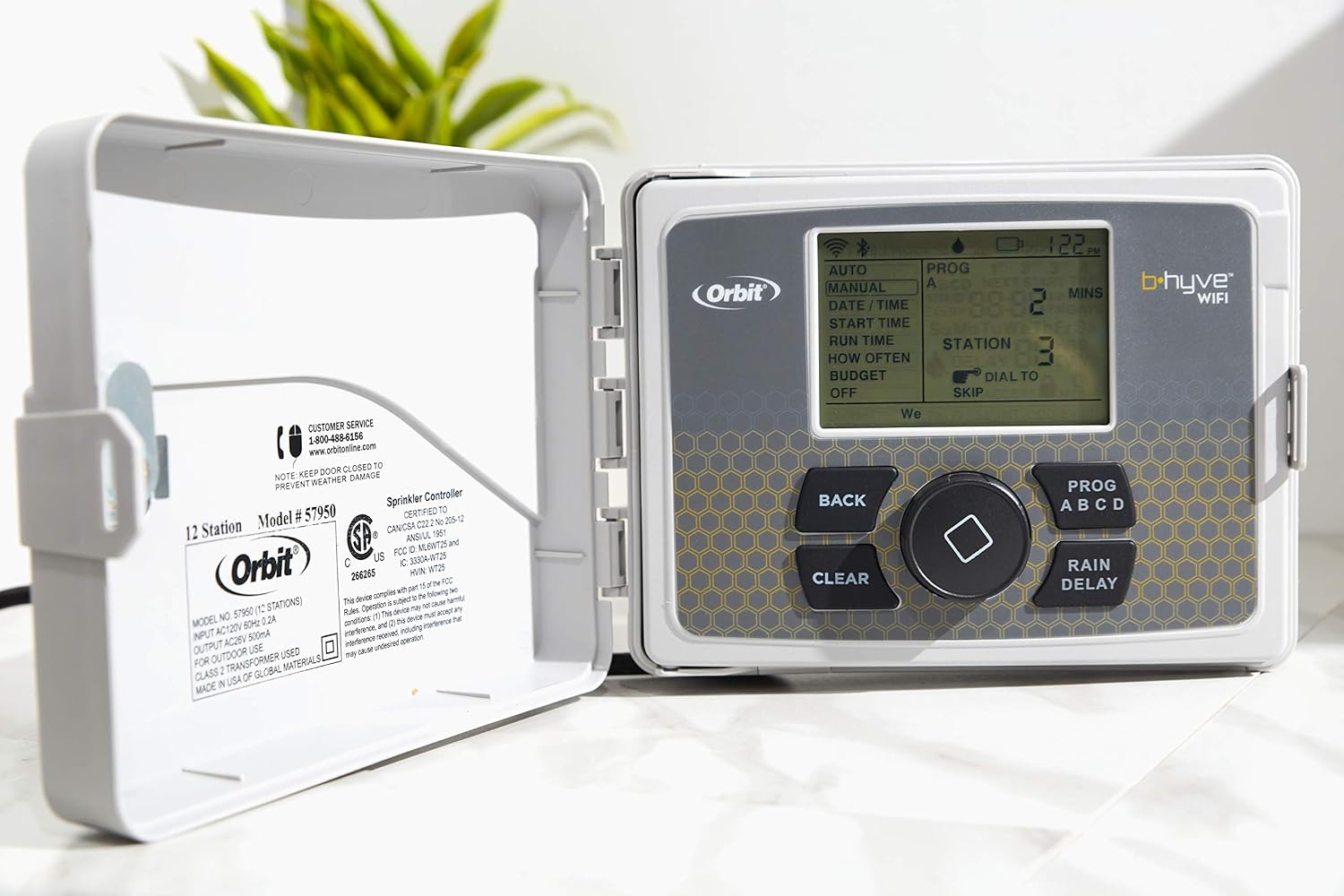
One reviewer note worth surfacing for outdoor-mount scenarios: the outdoor-rated B-hyve 8-zone and 12-zone units support a hardwiring option for permanent installations, but multiple owners report discovering this only through third-party video tutorials rather than through the included documentation. If you’re mounting one of these units in a weatherproof enclosure on an exterior wall and want a clean, battery-free install, that path exists — plan to find a walk-through video before install day rather than relying on the manual.
Zone-by-Zone Breakdown: Five Models, Five Buyer Profiles
Zone count is the most consequential decision in the lineup, and it’s where most buyers go wrong. The key reframe: zone count isn’t just about how many valves you have today — it’s about how many valves your correctly designed system should have. A common pattern noted in Family Handyman’s smart irrigation controller buying guide is that homeowners replacing a 6-zone dumb timer with a 6-zone smart controller discover they’re still running turf, drip beds, and a slope on the same zone because that’s how the previous owner wired it. The smart controller didn’t cause that problem, but it can’t solve it either. Before you spec zone count, map your actual valve count and add one or two for expansion.
B-hyve 4-Zone and 6-Zone: Entry-Level Indoor Models
These are plug-in indoor units designed for the simplest residential scenarios. The 4-zone is the fastest install in the lineup and appropriate for small suburban lots with three to four turf or bed zones and no plans to expand. The 6-zone is the smarter default for most first-time buyers: if your property has any complexity — a drip zone plus two or more turf zones — starting at 4 zones leaves you no room. This Old House’s smart controller installation guidance specifically notes that leaving one or two zones in reserve is best practice for any growing landscape.
Orbit
$77.97
In stock on Amazon
Check price on AmazonB-hyve 8-Zone: The Lineup’s Inflection Point
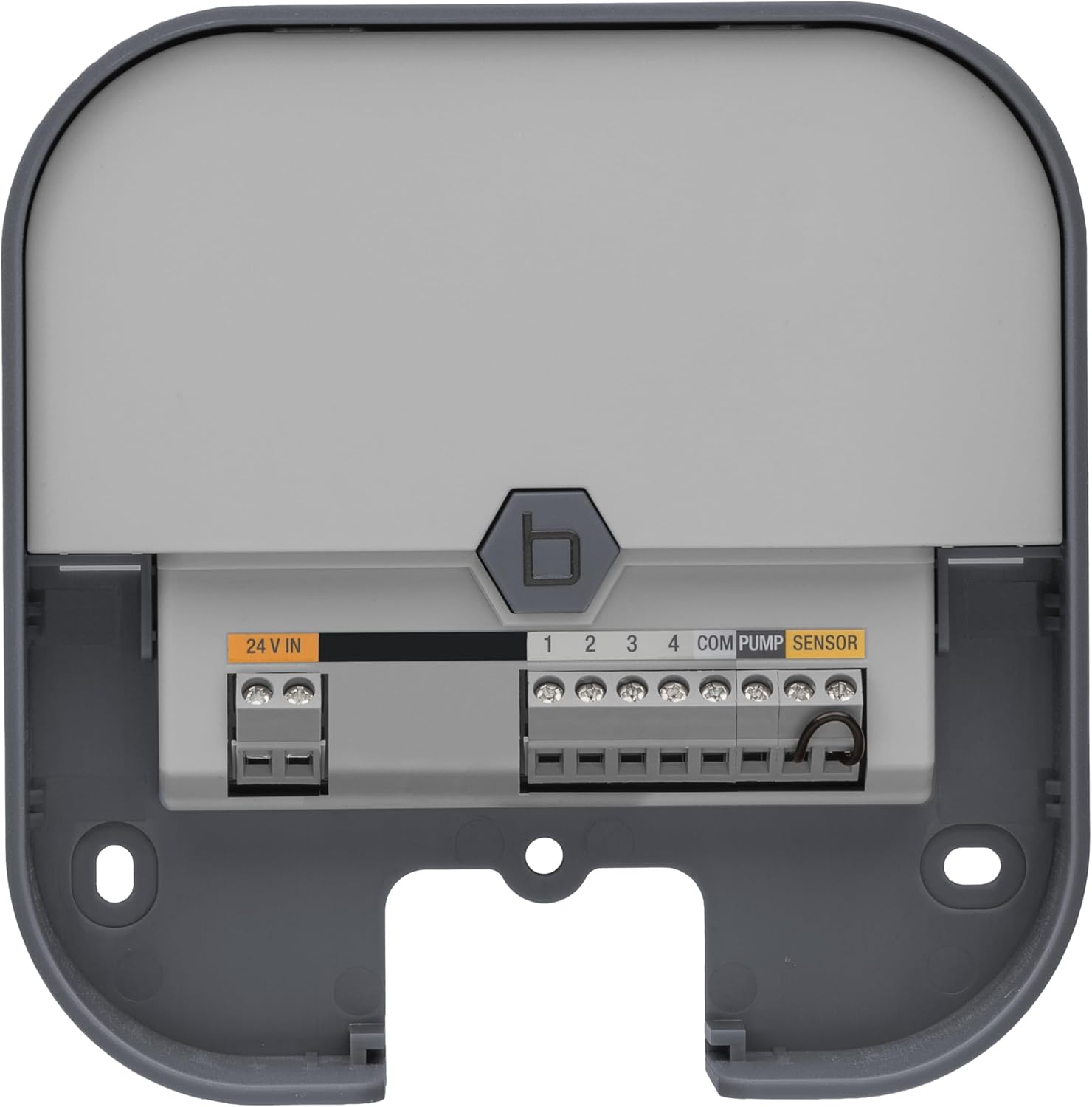
The 8-zone is where the B-hyve lineup becomes genuinely flexible. It’s available in both indoor and outdoor-rated versions — a distinction that matters if your valve box and transformer are garage-mounted or exterior-mounted rather than inside a utility closet. Owners with medium-complexity properties (three turf zones, two bed zones, one drip zone, and one zone held in reserve) land here most often. The outdoor model’s weatherproof housing earns solid marks for durability in owner accounts. If you’re doing a permanent exterior mount, budget time before install day to locate the hardwire instructions independently, as the included documentation doesn’t surface them clearly.
Orbit
$108.56
In stock on Amazon
Check price on AmazonB-hyve 12-Zone and XR 16-Zone: Serious Residential and Light-Commercial Reach
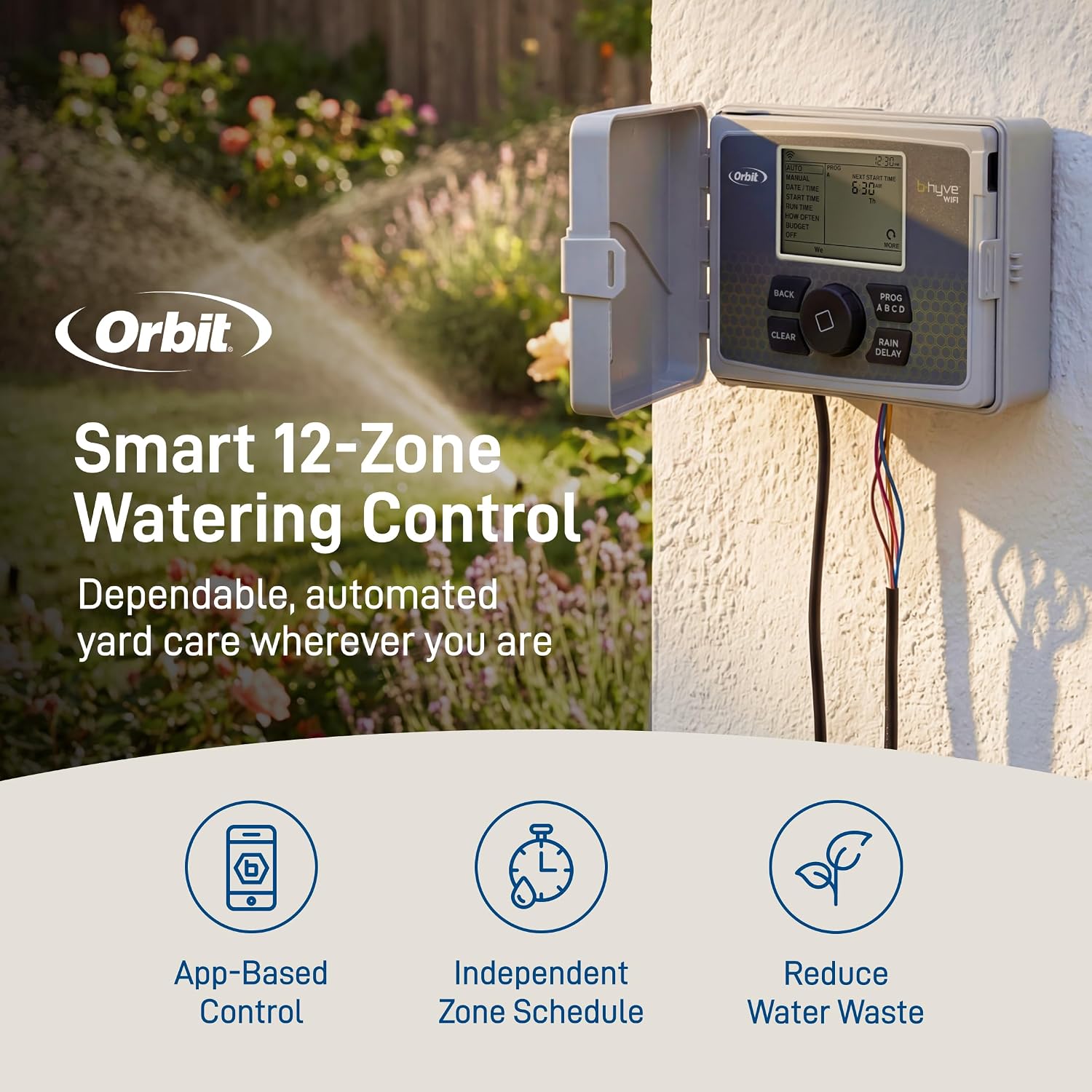
The 12-zone is where the B-hyve starts overlapping with light-commercial scenarios. Property managers overseeing a small multi-family building, a boutique nursery’s production beds, or a large residential property with dedicated zones for ornamental beds, vegetable gardens, and turf running simultaneously will find the 12-zone covers most single-site needs. Family Handyman’s smart irrigation buying guide identifies layered zone logic of exactly this kind — separating turf from drip from ornamentals — as best practice for meaningful water savings.
The XR 16-zone was designed for consolidation. The clearest use case: a homeowner replacing two aging 8-zone controllers that were each managing half of a large property. Running two separate controllers means two apps, two WiFi connections, and two sets of schedules that can’t coordinate with each other. The XR collapses that into a single interface. If you’re managing more than 12 zones at a single address, the decision is one XR or two 8-zone units. One XR wins on management simplicity; two 8-zone units win if you need physical redundancy (one controller failure doesn’t kill the whole system). For most single-site installs, the XR consolidation argument is strong.
Orbit
$117.39
In stock on Amazon
Check price on AmazonWhere B-hyve Sits in the Broader Market
There’s a recurring note in long-run reviews from owners who upgraded from older timer-based systems — particularly Hunter X-Core users — that the jump from a non-connected timer to a WiFi-enabled, weather-aware controller feels disproportionately large relative to the price difference. The app’s schedule-adjustment feedback, automatic skip notifications, and historical watering logs are features that timer-only owners simply didn’t have access to without a separate add-on module.
That said, buyers considering a B-hyve as a step up from a Rachio 3 or Hunter Pro-HC should understand the ceiling. The Irrigation Association’s Smart Controller Technology Overview classifies ET-based (evapotranspiration-based) controllers by the precision of their input data. The Rachio 3 and Pro-HC tier layer in more granular soil-type inputs, real-time ET calculations, and deeper integration with third-party sensors. B-hyve uses a forecast-approximate ET approach — honest and capable for the mid-tier residential market, but not the top of the stack. For the first-time component builder stepping up from a boxed Orbit or Melnor kit, B-hyve is the right next rung. For a fully spec’d multi-zone system with pressure-regulated drip manifolds, flow sensors, and rotary nozzles already in place, it’s worth evaluating whether a Rachio 3 or Pro-HC better matches the system’s existing precision.
Water Rebates: The Angle Most Buyers Miss
Because every B-hyve controller in the lineup carries EPA WaterSense certification, they qualify for utility rebate programs offered by participating water districts. Per the EPA WaterSense Program’s Labeled Products documentation, WaterSense-certified smart irrigation controllers are among the most commonly rebated product categories in utility conservation programs. This Old House’s smart controller installation coverage specifically flags the rebate angle as a step buyers should research before purchasing, since the rebate can meaningfully offset the controller’s cost. In some districts, the B-hyve 8-zone or 12-zone effectively costs what the 4-zone costs after rebate. Check your water utility’s website or call their conservation department before you buy.
If X, Then Y: The Decision Rule
- 4 zones or fewer, simple single-exposure yard: 4-Zone B-hyve. Don’t overspend on headroom you won’t use.
- 5–6 zones, or expect to add one drip circuit in the next two years: 6-Zone. The expansion buffer is worth it.
- 7–8 zones, or need outdoor mount (garage, exterior wall, weatherproof enclosure): 8-Zone outdoor model. Budget time to locate the hardwire instructions before install day.
- 9–12 zones, or managing a light-commercial single site: 12-Zone. This is the serious residential and small-property professional sweet spot.
- Consolidating two old controllers at the same address, or 13–16 zones: XR 16-Zone. The management simplicity argument wins cleanly over split-controller redundancy for most single-site scenarios.
- Microclimate prone to highly localized weather patterns: Add a physical rain sensor to any B-hyve model. Forecast-based delay is good enough for most properties; sensor-based delay is more accurate for properties where the forecast regularly diverges from ground truth.
Frequently Asked Questions
Do B-hyve controllers qualify for utility water rebates? Yes. All current B-hyve models carry EPA WaterSense certification, which is the qualifying credential most utility rebate programs require. Per the EPA WaterSense Program’s Labeled Products documentation, rebate amounts vary by water district — check your local utility’s conservation program before purchasing, since some districts rebate $50–$100 toward WaterSense-certified controllers.
What is the difference between forecast-based and sensor-based rain delay? Forecast-based delay — which B-hyve uses — triggers a watering skip when the weather service predicts rain above a threshold in your area. Sensor-based delay uses a physical device installed at your property to detect actual precipitation. As the Irrigation Association’s Smart Controller Technology Overview notes, these are distinct categories: forecast-based is more convenient and requires no additional hardware; sensor-based is more accurate for microclimates where local conditions regularly diverge from regional forecasts.
Can I hardwire the outdoor B-hyve unit instead of using batteries? Yes, but the included documentation doesn’t surface this clearly. Owners report discovering the hardwire option through third-party video tutorials. If you’re doing a permanent exterior mount and want a battery-free install, the option exists — plan to find a walk-through video before your install day.
Will the B-hyve app work if my WiFi router goes down temporarily? The B-hyve controller stores its active schedule onboard. If your router goes offline, the controller will continue running its last programmed schedule locally. You lose real-time weather-based adjustments and remote app control during the outage, but the system won’t go dark.
Can I manage multiple B-hyve controllers at different properties from one app? Yes. The B-hyve app supports multi-controller management under a single account. Each controller appears as a separate device in the app with its own schedule and history — a feature light-commercial operators and property managers identify as genuinely useful.
Does the on-device screen allow full programming without the app? B-hyve controllers include a basic on-device interface for manual runs and schedule overrides, but full schedule programming is app-dependent. The on-device controls are best understood as an override and manual-start interface, not a standalone programming environment.