September 5, 2026 • Tomás Guerreiro • 12 min reading time • Specs verified June 18, 2026
Building a Multi-Zone Valve Manifold: Orbit Preassembled, Hunter PGV Dura, and the Rain Bird Action Machining Option Compared
Building a Multi-Zone Valve Manifold: Orbit Preassembled, Hunter PGV Dura, and the Rain Bird Action Machining Option Compared
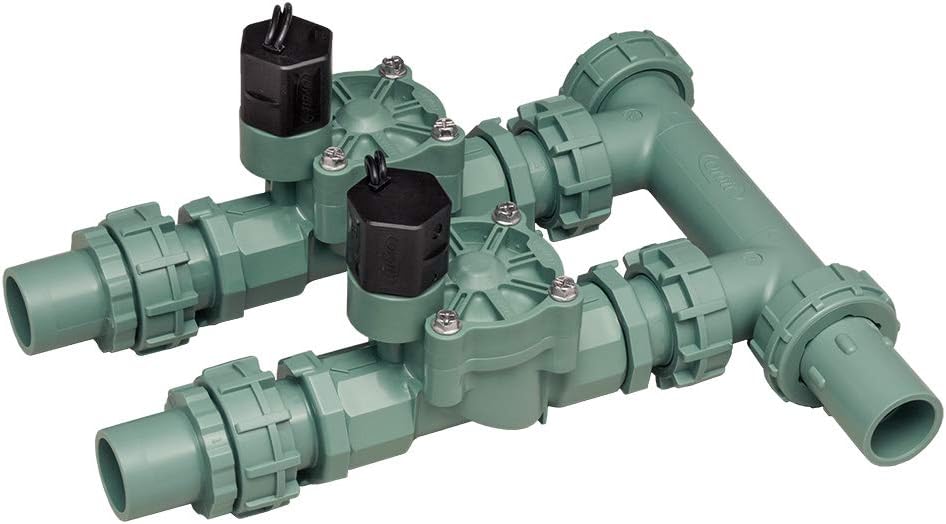
If you’ve never heard the term “valve manifold” before, here’s the quick version: your irrigation system needs a separate automatic valve — a water-on/water-off gate controlled by your timer — for every zone (a group of sprinkler heads that run together). A manifold is simply a pre-plumbed cluster of those valves sharing one water-supply inlet, so instead of solvent-welding twenty feet of individual PVC fittings yourself, you drop in a single assembly and wire it up. Preassembled manifolds save a meaningful amount of shop time, reduce leak points, and make long-term repairs dramatically easier than a buried tangle of glued joints. This article compares three of the most-discussed options at the $80–$300 kit level — the Orbit Preassembled Manifold, the Hunter PGV Dura Manifold, and the Rain Bird Action Machining Manifold — with enough specifics to settle your buying decision before you order.
| EDITOR'S PICKHunter PGV101-MM 6 Zone Dura Ma… | Mid-tierOrbit 57250 2-Valve Heavy Duty… | Budget pickOrbit 57184 Double Union Couple… | |
|---|---|---|---|
| Zones | 6 | 2 | — |
| Valve type | PGV101G | — | — |
| Flow control | ✓ | — | — |
| Connection | Slip | — | Swivel |
| Material | — | PVC | — |
| Preassembled | ✓ | ✓ | — |
| Price | $226.94 | $59.97 | $4.97 |
| See on Amazon → | See on Amazon → | See on Amazon → |
Why Preassembled Beats Scratch-Built (And Where the Trade-offs Live)
The traditional alternative is a glue-joint PVC manifold built from individual slip-fit fittings, risers, and nipples. It costs less in raw materials. It also demands precise cuts, a square solvent-welded assembly that has to cure before you can pressure-test, and zero tolerance for a mis-cut branch that would require cutting out the whole section and starting over.
Reviewers across all three manifold brands cited time savings as the decisive factor — a preassembled unit can go from the box to a pressure-tested install in a single afternoon. The Irrigation Association’s Landscape Irrigation Best Management Practices (2023 edition), published by the Irrigation Association and available through irrigation.org, recommends pressure-testing any new valve assembly before backfilling. A preassembled unit makes that step trivially easy: thread the supply side onto your main line, cap the zone outlets temporarily, charge the line to operating pressure, and watch for weepers. That’s thirty minutes of insurance you simply can’t do as cleanly with wet glue on a scratch-built manifold.
The legitimate trade-off is modularity. Glue-joint PVC lets you engineer any topology — T-junctions, offset branches, zone spacing to the inch. Preassembled kits are opinionated about zone count, outlet spacing, and port sizing. If those choices match your install, you win on every dimension. If they don’t, you’re in modification territory, and that’s where each brand differs sharply.
Head-to-Head: Three Manifold Tiers Compared
The three products reviewed here span a clear price and performance ladder. Each section below is written to answer the specific questions that cause buyers to return or regret a purchase.
Orbit Preassembled Manifold: The Practical Entry Point
The Orbit Preassembled Manifold is the entry point most first-time builders encounter — it’s broadly distributed, competitively priced, and ships in 3-zone and 4-zone configurations. The valves are 1-inch-inlet with ¾-inch zone outlets, which covers the vast majority of residential zone flows.
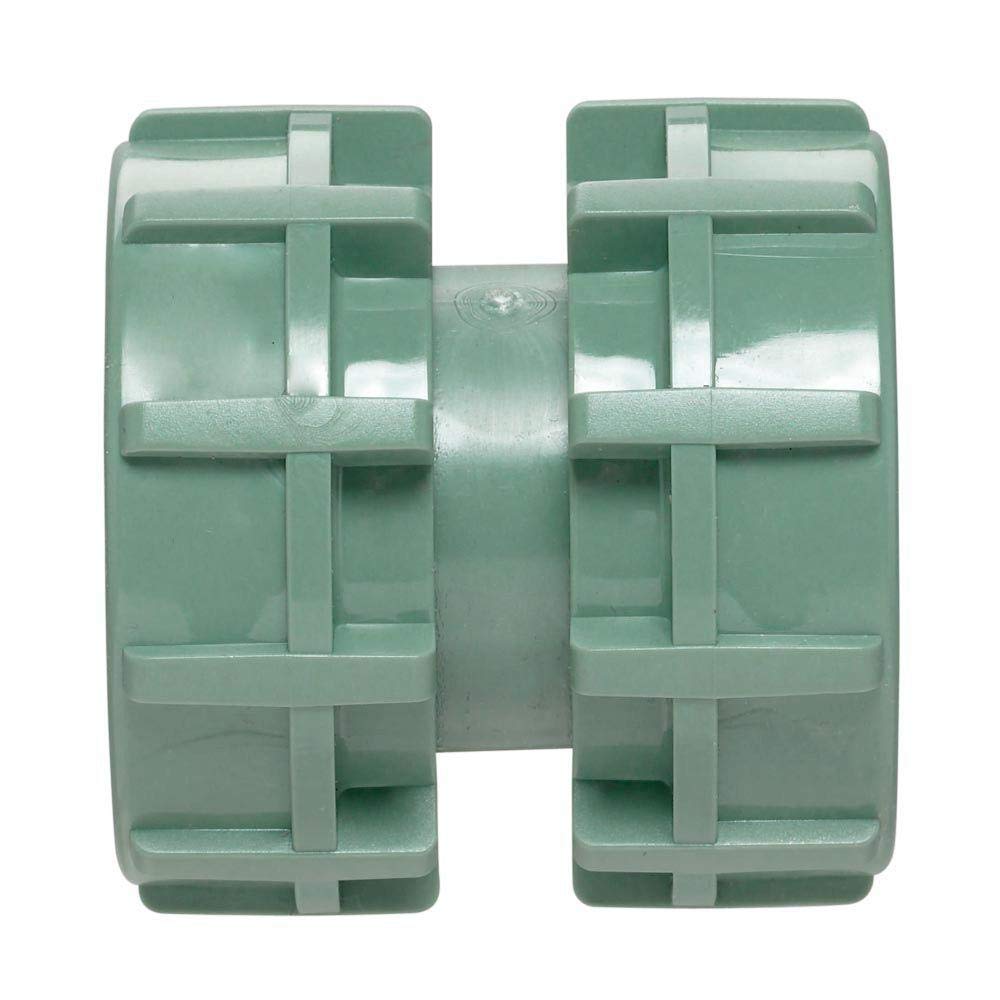
The double-union coupler problem. The single most-repeated frustration in Orbit manifold reviews is discovering mid-install that connecting two manifolds end-to-end — the natural move when you need more zones than one unit covers — requires a double-union coupler sold separately and not clearly flagged in most product listings. Multiple owners report a second supply run to find this fitting. If your design calls for 5, 6, or 7 zones, search your retailer for “Orbit double-union manifold coupler” and add it to your order at the same time as the manifold. Do not rely on a generic search for “double union coupler” — many non-compatible results surface under that term.
The valve box fit. A frequently overlooked practical detail: the Orbit manifold’s rectangular base fits a standard 12-inch rectangular valve box and sits flush without the improvised wood-block shimming that round manifolds often require. It does not fit a 6-inch box. If you’re pulling permits or working in a subdivision with an HOA that specifies valve box dimensions, verify before you dig.
Repairability. Orbit’s individual zone valves are field-replaceable, meaning a failed solenoid or diaphragm doesn’t take out the whole manifold. Replacement diaphragm kits are available and affordable — a meaningful long-term argument for a product at this price level.
| Spec | Orbit (4-zone) |
|---|---|
| Inlet | 1 in. |
| Zone outlets | ¾ in. |
| Expansion method | Double-union coupler (sold separately) |
| Valve box fit | 12 in. rectangular |
| Individual valve replaceable? | Yes |
Orbit
$4.97
In stock on Amazon
Check price on AmazonHunter PGV Dura Manifold: Commercial Internals, One Field-Replacement Question
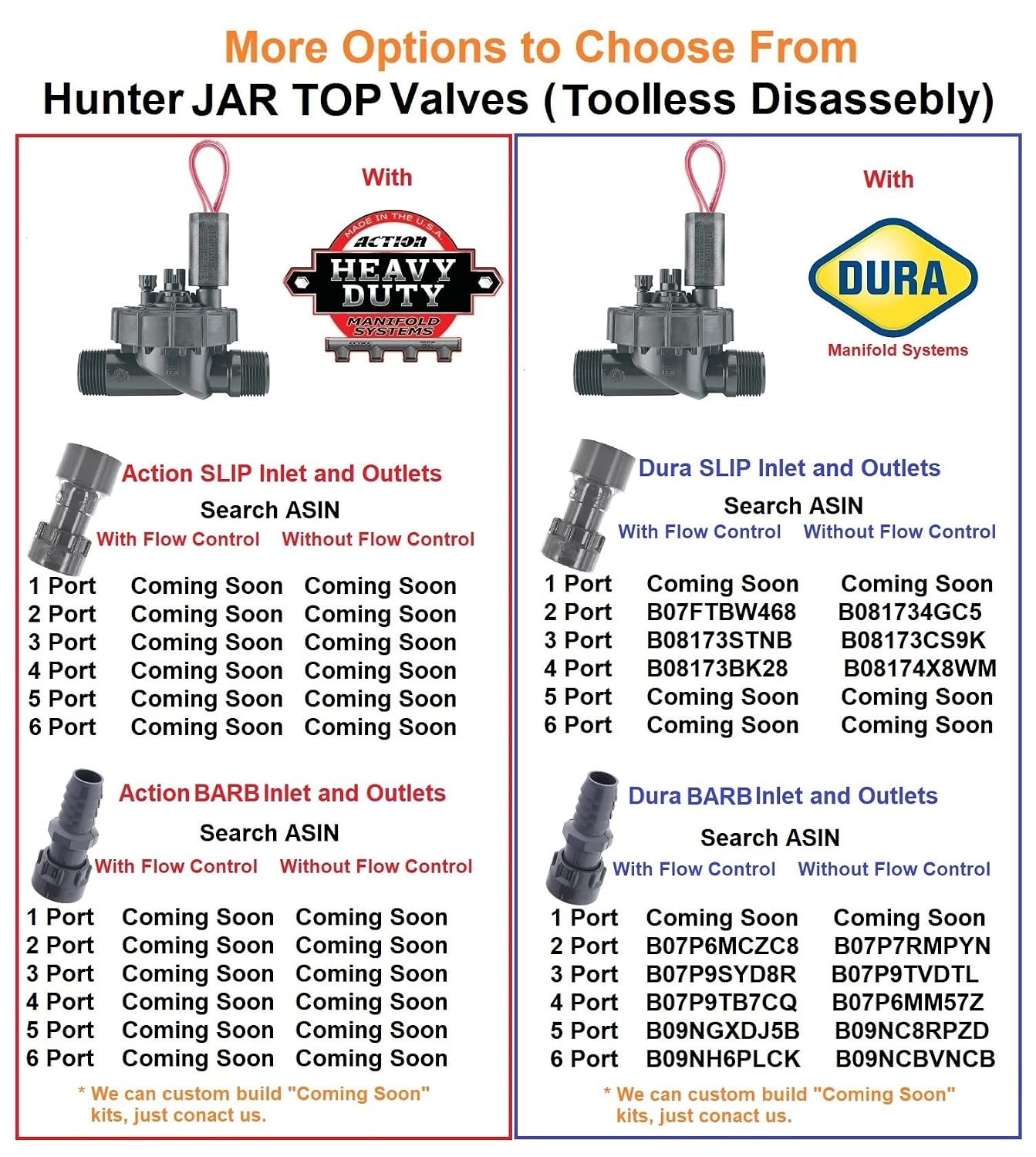
The Hunter PGV Dura Manifold steps up to commercial-grade valve internals — the same PGV valve body that landscape contractors specify on multi-property accounts. Owners consistently report hand-tight seals across every joint with zero leaks even after years of seasonal cycling, which is the direct payoff of Hunter’s compression-fit union connections rather than glue.
The single-valve failure scenario and what it means for spare parts. There is at least one documented owner account of a single valve failure on a 6-zone Hunter PGV Dura unit causing an extended uncontrolled run — the kind of event that matters for your water bill and for root health. The practical question this raises: can you replace one Hunter PGV valve without scrapping the manifold?
The answer, per Hunter Industries’ PGV Series Valve Installation and Service Guide (published by Hunter Industries as manufacturer documentation), is yes — with a clear caveat. Hunter PGV valves in the Dura Manifold are connected via union fittings, which means an individual valve can be isolated, disconnected at its unions, and replaced with a standard Hunter PGV globe or angle valve body without disturbing adjacent valves or the manifold structure. The process requires shutting off the supply, relieving pressure, and unscrewing the unions on both sides of the failed valve — no cutting, no glue, no manifold replacement. However, you need to order the correct PGV body (1-inch globe or angle, depending on your manifold port orientation) before the repair, which means a 24–48 hour shipping window in most locations. If you’re running critical turf or a commercial property where an extended soak causes real damage, keep a spare PGV valve body on your shelf.
Thread tape vs. silicone grease. Hunter’s union connections use O-ring seals, not tapered NPT threads. That distinction matters for assembly: do not use PTFE thread tape on O-ring port connections. Thread tape on an O-ring seat causes the tape to bunch, preventing full compression and creating the exact leak path you’re trying to prevent. Apply a thin film of silicone grease — not petroleum-based lubricant, which degrades rubber — to the O-ring before hand-tightening. Hunter Industries’ PGV Series Valve Installation and Service Guide specifies this technique, and it is the dominant approach reported by owners who achieve leak-free installs on the first try.
Valve box fit. The Hunter PGV Dura 6-zone unit is a larger assembly than the Orbit 4-zone. For a 3- or 4-zone unit, a 12-inch box provides adequate room; for 6 zones, budget for a 14-inch or larger box if you want expansion space for additional wiring.
| Spec | Hunter PGV Dura (6-zone) |
|---|---|
| Inlet | 1 in. |
| Zone outlets | 1 in. |
| Connection type | Union fittings (O-ring sealed) |
| Valve box fit | 14 in. recommended for 6 zones |
| Individual valve replaceable? | Yes, via union disconnect |
Orbit
$59.97
In stock on Amazon
Check price on AmazonRain Bird Action Machining Manifold: Brass Ports and the Pre-Install Pressure Test
The Rain Bird Action Machining Manifold is the precision-machined option in this comparison — machined brass body ports rather than injection-molded plastic threads, which is the core of its appeal to owners who’ve dealt with cracked plastic fittings after winter freeze-thaw cycles. Rain Bird’s Action Manifold Assembly Instructions, published by Rain Bird Corporation as part of their technical documentation library, covers the assembly sequence in detail. The field technique owners report most reliably is applying silicone grease to every O-ring before assembly, hand-tightening to seat, then adding only a quarter-turn with a strap wrench — no thread tape, same logic as the Hunter.
The pre-install pressure test as a quality gate. One owner account that stands out in aggregated reviews of this product: the installer performed a bench pressure test of the fully assembled manifold before trenching — pressurizing to system operating pressure with the zone outlets capped — and caught a factory-defective valve diaphragm that was weeping at 45 PSI before a single shovel of soil was moved. That single step saved a warranty claim and a trench reopening. Rain Bird’s Action Manifold Assembly Instructions support pre-installation testing as a recommended step. Family Handyman, in its guide to sprinkler system installation published at familyhandyman.com, similarly identifies pressure testing of all valve assemblies as a best practice before backfill. The Irrigation Association’s Landscape Irrigation Best Management Practices (2023 edition), published by the Irrigation Association, reinforces this recommendation across all valve assembly types. For any manifold brand, this is thirty minutes well spent.
Where the Action Machining option makes sense. The Rain Bird manifold sits at a higher per-zone cost than the Orbit, but the machined brass ports represent a genuine long-term durability argument in climates with freeze-thaw stress or high mineral content water that degrades plastic threads over five-plus seasons. If your install is in USDA Zone 5 or colder, or if your water report shows high hardness (above 200 mg/L), the brass port construction justifies the price delta.
| Spec | Rain Bird Action Machining |
|---|---|
| Inlet | 1 in. |
| Zone outlets | 1 in. |
| Port material | Machined brass |
| Connection type | O-ring sealed unions |
| Individual valve replaceable? | Yes |
Hunter
$226.94
In stock on Amazon
Check price on AmazonZone Count Decision: 4-Zone or 6-Zone, and How to Pick
The most common mid-install regret across all three manifold brands is under-speccing zone count. The Irrigation Association’s Landscape Irrigation Best Management Practices (2023 edition), published by the Irrigation Association, recommends designing to your ultimate zone count, not your current zone count — future zones added ad hoc require coupling adapters, additional valve boxes, and more wire runs that compound installation complexity.
The practical decision rule:
- Under 5,000 sq ft of irrigated area with a firm zone plan: a 4-zone manifold with one expansion port is a clean, right-sized solution.
- 5,000–15,000 sq ft, or any uncertainty about final zone count: start with a 6-zone unit. The incremental cost of two unused valve ports is far less than a second manifold installation later.
- 6+ confirmed zones today: plan for two manifolds from day one and order the appropriate coupling hardware at the same time as your manifolds, not after.
Frequently Asked Questions
Do I need to buy the Orbit double-union coupler separately to connect two Orbit manifolds? Yes — the coupler is sold separately and is not included or clearly flagged in most Orbit manifold listings. Multiple installers have flagged this as a mid-project surprise. Search your retailer for “Orbit double-union manifold coupler” when placing your original order, not after you’re mid-install.
Are individual Hunter PGV valves replaceable if one fails without replacing the entire manifold? Yes. Hunter PGV Dura Manifolds use union connections at each valve, so a failed valve body can be isolated, disconnected at both unions, and swapped with a standard Hunter PGV globe or angle body without disturbing the rest of the manifold. Per Hunter Industries’ PGV Series Valve Installation and Service Guide (Hunter Industries manufacturer documentation), no cutting or gluing is required. Keep a spare valve body on hand if downtime matters.
Should I use thread tape or silicone grease on manifold O-ring connections? Use silicone grease on O-ring connections — not PTFE thread tape. Thread tape on an O-ring seat prevents full compression and creates leak paths. Apply a thin film of silicone grease, hand-tighten to seat, and add a quarter-turn maximum. This applies to both the Hunter PGV Dura and Rain Bird Action Machining manifolds.
What size valve box fits a 3-valve or 4-valve preassembled manifold with room to expand? A 12-inch rectangular valve box accommodates 3- and 4-zone manifolds from all three brands reviewed here. The Orbit rectangular base is confirmed by installers to fit 12-inch boxes without shimming. For 6-zone units or if you’re planning future expansion, step up to a 14-inch box.
Can I pressure-test a manifold before backfilling to catch bad valves, and how? Yes, and you should. Cap all zone outlets with threaded caps, connect the supply side to your main line or a hose-thread adapter for a bench test, charge to your system’s operating pressure, and let it sit for 15–30 minutes. Watch for weepers at any joint or valve body. Family Handyman (familyhandyman.com) identifies this step as a best practice for all valve assemblies in its sprinkler system installation guide. This is exactly how one Rain Bird Action Machining owner caught a defective diaphragm before backfilling — avoiding a trench re-open and a warranty delay.
How do I choose between a 4-zone and 6-zone manifold if I’m not sure how many zones I’ll eventually need? Default to the 6-zone unit if there’s any uncertainty. Unused ports cost you nothing at install time and save significant rework later. The only reason to choose a 4-zone unit is if you have a firm zone count of 4 or fewer with no expansion plans — a rare situation on any property above 3,000 sq ft of irrigated area.
The Buying Decision
Here is the clean decision matrix across all three tiers:
Orbit Preassembled Manifold is the best choice for budget-conscious installs and first-time component builds where you want field-replaceable valves and broad parts availability. Order the double-union coupler at the same time as the manifold if there is any chance you will expand to 5 or more zones.
Orbit
$4.97
In stock on Amazon
Check price on AmazonHunter PGV Dura Manifold is the best choice for contractors and serious DIYers who want commercial valve internals, hand-tight O-ring seals, and union-style individual valve replacement without manifold replacement. Keep a spare PGV valve body on the shelf. Do not use thread tape on O-ring ports.
Orbit
$59.97
In stock on Amazon
Check price on AmazonRain Bird Action Machining Manifold is the best choice for climates with freeze-thaw stress or high-mineral water, and for any installer who wants machined brass port durability over a 10-plus-year horizon. Pre-install pressure testing before backfill is non-negotiable with this unit — it is how you validate factory quality control before the trench closes.
Hunter
$226.94
In stock on Amazon
Check price on AmazonWhichever you choose: measure your GPM and PSI budget first, design your zone count before you order, and pressure-test before backfilling. Those three steps prevent the problems that generate the one-star reviews across all three of these products.