August 13, 2026 • Tomás Guerreiro • 12 min reading time • Specs verified June 18, 2026
MP Rotator Nozzle Pressure, Coverage, and Calcium Clog Problems: What Long-Term Owners Actually Report
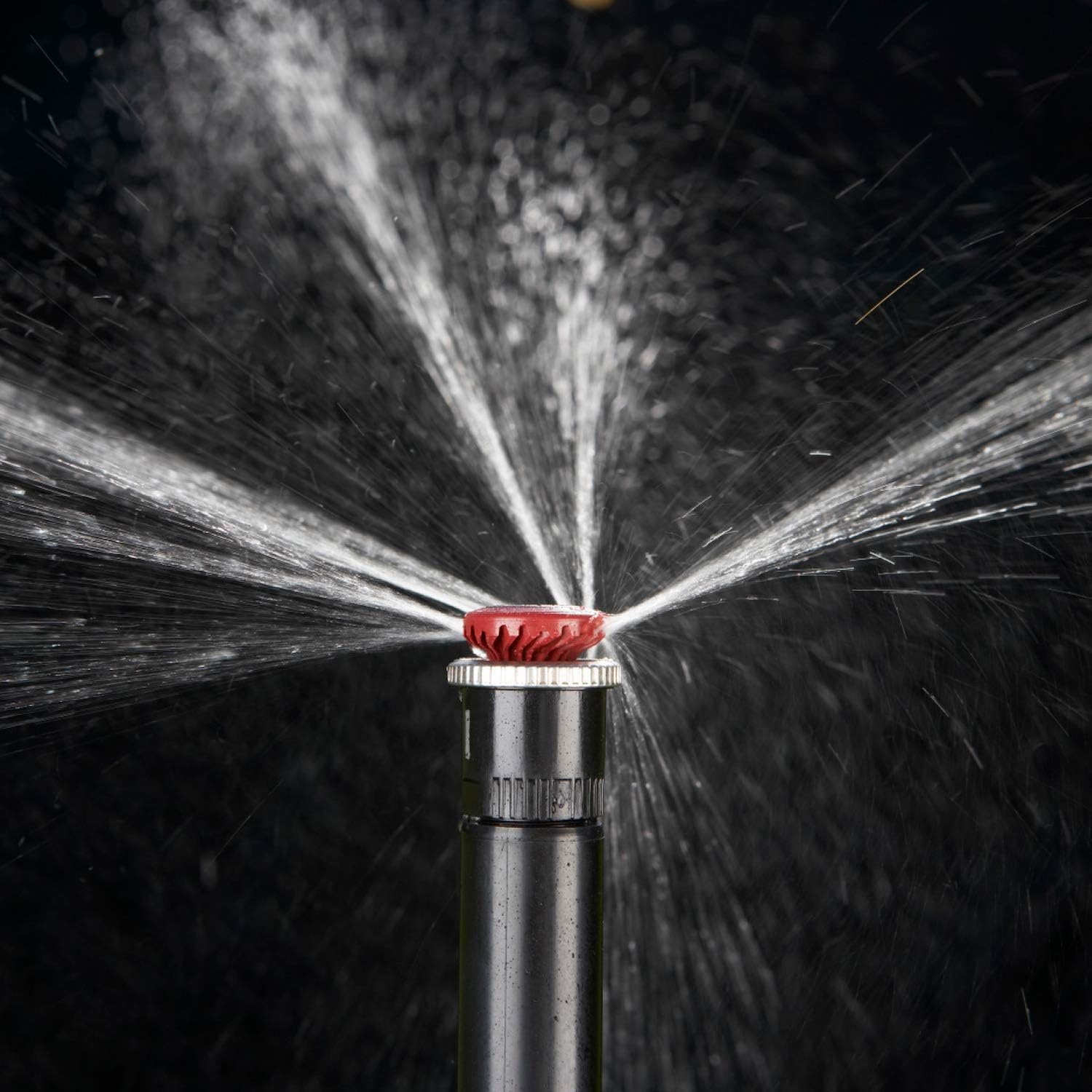
If you’ve ever looked at your lawn after a cycle and wondered why the grass near your sprinkler heads is wet but the middle of the yard is still dry and pale, you’ve already bumped into the central challenge of rotary nozzles. An MP Rotator (the letters stand for Multi-Trajectory Rotating nozzle, originally developed by Walla Walla Sprinkler Company and now manufactured under the Hunter Products umbrella) is a nozzle insert — meaning it drops into the same pop-up sprinkler body you probably already own — that spins multiple streams of water outward in slow arcs instead of blasting a wide fan of mist. That spinning, low-volume delivery is what makes MPs genuinely more efficient on sloped turf and clay soil. But it also means they put down water at roughly half the rate of a standard fixed-spray nozzle, and that single fact has generated more confusion, disappointment, and mistaken returns than almost any other variable in residential irrigation. This article compiles what long-term owners and independent irrigation professionals consistently report: the runtime math, the pressure sweet spot, the calcium clog fix, and the specific nozzle variants that solve problems nothing else in the lineup addresses.
The Double-Runtime Problem (and Why Nobody Warns You)
The most consistent theme across long-run owner accounts is this: MP Rotators have a precipitation rate (the speed at which they apply water, measured in inches per hour) that runs roughly 0.4–0.6 in/hr, compared to 1.0–2.0 in/hr for conventional fixed-spray heads. The Irrigation Association’s Landscape Irrigation Best Management Practices document flags matched precipitation rate as foundational to avoiding runoff, and MPs are spec’d to deliver uniformity precisely because they run slow. The tradeoff is time on the clock.
By the numbers:
| Nozzle type | Typical precip rate | Runtime to deliver 1 inch |
|---|---|---|
| Fixed spray (standard) | 1.5 in/hr | ~40 minutes |
| MP Rotator | 0.5 in/hr | ~120 minutes |
| MP Rotator (high-pressure adjusted) | 0.35 in/hr | ~170 minutes |
Owners who swap MPs into a zone without adjusting the controller schedule reliably report the same outcome: grass looks dry, they blame the nozzle, they switch back. The fix is purely a schedule change — no hardware, no service call. If your controller runs a fixed-spray zone for 12 minutes, the equivalent MP Rotator zone needs approximately 25–35 minutes. Smart controllers like the Rachio 3 or Hunter Pro-HC handle this automatically when you update the nozzle type in the zone settings; the controller’s ET (evapotranspiration)-based algorithm recalculates run time using the nozzle’s precipitation rate from its database. If you’re running a non-smart controller, you’re doing this arithmetic manually, and it’s worth doing before you pull a single nozzle out of the ground.
UC Agriculture and Natural Resources guidance on landscape irrigation scheduling reinforces that low-precipitation-rate nozzles require longer cycles but dramatically reduce runoff on slopes or compacted soils — the efficiency gain is real, it just takes longer to deliver.
Pressure: Where MP Rotators Are Actually Better Than You Think
Here’s the counterintuitive part that trips up experienced installers as much as newcomers: MP Rotators operate at lower pressures than most fixed-spray zones, and this is a feature, not a limitation.
Hunter rates MP Rotator nozzles at an operating range of 25–45 PSI (pounds per square inch), with optimal performance cited at 30–40 PSI at the nozzle head. Compare that to standard fixed-spray nozzles, which often spec at 30 PSI but in practice produce fogging and mist drift above 40 PSI — the kind of drift that waters your driveway, your fence, and the neighbor’s car rather than the turf. The EPA WaterSense program’s irrigation controller efficiency guidance specifically calls out misting from over-pressurized spray heads as a primary cause of waste in residential systems.
One owner account that circulates frequently in irrigation forums describes a chronically patchy low-pressure zone — probably pulling 22–28 PSI at the heads — where fixed-spray nozzles had always underperformed. After switching to MP Rotators, the same owner described the coverage as “amazing” and noted consistent coverage where they had never achieved it before. That’s not magic. That’s a nozzle designed to function in a lower pressure window.
The failure mode runs in both directions, though. At pressures above 45 PSI, MP Rotators can lose their characteristic slow arc rotation, effectively stalling or producing uneven streams. Colorado State University Extension’s irrigation efficiency documentation notes that pressure regulation at the zone level — via pressure-compensating (PC) screens or pressure-regulating heads — is the reliable solution when municipal supply pressure runs high. If your supply pressure at the meter is above 70 PSI (which is common in many utility districts), a whole-system pressure regulator or per-head pressure-regulated bodies are worth budgeting for.
Decision rule: If your static pressure at the zone is under 30 PSI, MP Rotators are likely to outperform any fixed-spray nozzle you could substitute. If your pressure is consistently above 50 PSI at the head, install pressure-regulating pop-up bodies or a zone regulator before swapping nozzles — otherwise you’re not solving the real problem.
The MP3000 vs. MP3500: When the Extra Throw Radius Actually Matters
Hunter’s MP Rotator family is organized by throw radius, and most residential zones are covered by the MP1000 (8–12 ft), MP2000 (13–21 ft), and MP3000 (18–30 ft). The MP3500 (23–35 ft) sits above that, and in most online discussions it shows up specifically because someone ran into a coverage problem that the MP3000 couldn’t solve.
The practical scenario: a long rectangular turf strip with heads placed 25 feet apart, where the MP3000’s published radius comes up short at real-world pressure and the center of the strip dries out. Owners who make the switch to MP3500 in these applications report closing that gap without adding additional heads or rerouting lateral pipe — a relevant savings when you’re looking at trenching cost. This Old House’s sprinkler system installation coverage emphasizes head-to-head spacing (each head should reach the adjacent head) as the baseline for uniform coverage, and the MP3500 exists to make that possible in wider-spaced commercial or estate layouts without running additional zones.
If your zone was designed for heads spaced at or beyond 28 feet, the MP3500 is worth speccing. If your spacing is under 25 feet, the MP3000 will cover it at appropriate pressure without the extra cost.
MP Side Strip Nozzles: Solving the Driveway Spray Problem
One specific real-world use case that owners report clearly: replacing standard nozzles in a narrow turf strip alongside a driveway, sidewalk, or fence line with MP Side Strip nozzles eliminates two chronic problems simultaneously — mist drift that soaks pavement and wasted water that runs off impervious surfaces.
The MP Side Strip is a rectangular-pattern nozzle (available in 4×30 ft and 5×30 ft patterns) designed to be mounted flush against a hardscape edge, throwing water in one direction only. Owners who have made this swap describe the before state as a permanent wet driveway and water staining on concrete edges, and the after state as clean dry pavement with a uniformly irrigated strip. The Irrigation Association’s best practice documentation explicitly identifies edge nozzle selection as a factor in reducing impervious-surface runoff — not just an aesthetic preference.
One caveat that appears in owner reports: the MP Side Strip is not a comfortable fit for strips narrower than 5 feet. The nozzle’s distribution pattern is calibrated for a minimum depth of about 4–5 feet; below that, you’re likely to overshoot the inner edge of the turf and under-water near the head. Placement should be at the hardscape edge itself, ideally at or within a few inches of where turf meets pavement. Clearance to a wall or fence on the opposite side should be at least 4 feet to avoid splash-back onto structures.
Calcium Deposits: The Long-Term Clog That Catches Hard-Water Owners
In regions where municipal water supply has high mineral content — most of the intermountain West, portions of the Southwest, and hard-water pockets throughout the Southeast — long-term MP Rotator owners in 3+ year use report a pattern of gradual performance loss: reduced throw distance on specific heads, slowed or stalled rotation, and uneven stream output that doesn’t respond to simple cleaning.
The mechanism is calcium carbonate buildup inside the nozzle’s turbine mechanism. Unlike a fixed-spray nozzle where a clog at the orifice is visible and usually clearable with a pin, the MP Rotator’s internal turbine is where the real blockage accumulates and where a rinse under running water won’t reach it.
The solution owners consistently describe: overnight soaking in a diluted white vinegar solution (roughly one part vinegar to four parts water). The nozzle is removed from the body, submerged, and left for 8–12 hours. Most report that rotation and distance recover fully after a single soak and rinse cycle. For severe buildup, a second soak is sometimes required.
This is documented enough across irrigation professional forums and owner reports that it’s worth building into a seasonal maintenance plan in hard-water areas — pull a sample of heads annually, check for performance drop, soak any that show reduced radius before assuming you need replacements.
The Hunter Adjustment Tool: One Service Call Saved
MP Rotators are adjustable for arc (the angle they cover) and left-edge position — the two settings that determine where the nozzle throws and how wide. Both adjustments are doable with a flat-head screwdriver for the basic left-edge setting, but owners consistently report that arc expansion is where confidence erodes and errors creep in.
The Hunter MP Rotator adjustment tool is a purpose-made key that interfaces with both the arc adjustment collar and the nozzle socket in a way that a standard screwdriver doesn’t replicate reliably. One owner report that appears in detailed product reviews describes avoiding a $175 irrigation service call specifically because they were able to rediagnose and correct an arc setting that had crept during installation — work they would not have attempted confidently with a screwdriver alone.
The practical value: if you’re managing more than two or three zones of MP Rotators, or if you’re speccing a new install where arc adjustments will inevitably need fine-tuning after the first few cycles, the adjustment tool pays for itself quickly. It’s the kind of tool that costs almost nothing and ends up being the one you reach for every single service visit.
Frequently Asked Questions
How much longer do I need to run MP Rotator zones compared to my old fixed-spray heads? Plan for approximately 2–3x the runtime. If a fixed-spray zone ran for 12 minutes, start at 25–35 minutes with MP Rotators and adjust based on observed soil moisture. Smart controllers with nozzle databases will calculate this automatically once you update the zone’s nozzle type.
What water pressure do MP Rotators need, and how do I know if my pressure is too high? Hunter specs the operating range at 25–45 PSI at the nozzle. If streams are misting rather than forming clean arcs, or if rotation is inconsistent, pressure above 45 PSI is the likely cause. A simple gauge at the test port or head-removal point will confirm. Pressure-regulating pop-up bodies or a zone-level regulator are the hardware solutions.
Can I install MP Rotators in existing Hunter or Toro pop-up bodies without replacing the body? Yes, in most cases. MP Rotators are designed as drop-in replacements for standard ½-inch female-thread nozzle bodies used by Hunter, Toro, Rain Bird, and others. Verify thread compatibility by checking your existing body’s nozzle thread spec; the vast majority of residential pop-up bodies in current production accept them without modification.
How do I clear calcium deposits from an MP Rotator that has lost distance or rotation? Remove the nozzle from the body and soak it overnight in a 1:4 dilution of white vinegar and water. Rinse thoroughly and reinstall. Most owners report full performance recovery after a single soak. Repeat for severe buildup.
What is the difference between the MP3000 and MP3500, and when does the extra throw radius matter? The MP3000 covers 18–30 feet; the MP3500 covers 23–35 feet. Choose the MP3500 when head-to-head spacing on your zone exceeds 28 feet and center-strip dryness is a recurring problem the MP3000 doesn’t reach.
Do MP Side Strip nozzles work in strips narrower than 5 feet, and how close to a wall or fence can they be placed? The MP Side Strip is not well-matched to strips under 4–5 feet in depth. Narrower than that, the distribution pattern overshoots the inner turf edge. Place the nozzle at the hardscape edge and maintain at least 4 feet of clearance to any wall or fence to avoid structural splash-back.
Buying Decision
The decision framework here is straightforward. If your zone has low or marginal pressure (under 35 PSI at heads), clay or compacted soil that puddles under fixed-spray nozzles, or a slope where runoff is visible: MP Rotators are likely the right nozzle for the application — buy them, update your controller schedule to match the lower precipitation rate, and give the first full cycle the time it needs. If your system pressure runs above 50 PSI: install pressure-regulating bodies or a zone regulator first; MPs will underperform or behave erratically without it. If you’re in a hard-water region: build the overnight vinegar soak into your annual maintenance calendar from day one rather than waiting for visible performance loss. If you’re managing strips alongside hardscape: the MP Side Strip is the correct spec and eliminates a real-world problem that general-purpose nozzles cannot solve. The Hunter MP Rotator adjustment tool belongs in your service bag regardless of zone count — the one time you need it, you’ll be glad you have it.