September 9, 2026 • Tomás Guerreiro • 11 min reading time • Specs verified June 18, 2026
Impact Sprinklers vs. Gear-Drive Rotors: Rain Bird 32SA, Rain Bird 5000, and the P5R Plastic Impact Compared
If you’re setting up a sprinkler system — or upgrading one — you’ll quickly run into two very different types of heads that rotate to water a wide area. The first is the impact sprinkler, the classic clacking head that’s been around since the 1930s; it spins by the force of water pushing against a spring-loaded arm. The second is the gear-drive rotor, a quieter, more modern design that uses an internal turbine and gear mechanism to produce the same sweeping arc, but more smoothly and with finer control. Both do the same basic job — rotating coverage across turf or planting beds — but they do it differently, they fail differently, and they perform very differently depending on what comes out of your pipes. This article compares three specific heads that come up constantly among irrigation buyers: the Rain Bird 32SA (a brass gear-drive rotor aimed at the serious residential and light-commercial market), the Rain Bird 5000 (the best-selling mid-grade gear-drive rotor, widely used in HOA and residential installs), and the Rain Bird P5R (a plastic-body impact sprinkler that earns surprisingly passionate loyalty, especially from well-water users). By the end, you’ll know exactly which head fits your situation — and why the water source question matters more than most buyers realize.
The Core Mechanical Difference — and Why It Decides the Water-Source Question
Before running through the individual heads, this is worth internalizing: gear-drive rotors have internal turbines and small gear trains. Those mechanisms are precision-machined to tight tolerances, and they depend on relatively clean water moving through small passages. Impact sprinklers, by contrast, are mechanically blunt — a weighted arm hits the deflector, the body spins, repeat. There is no turbine. There is no gear mesh. Water moves through a single open nozzle.
That difference becomes decisive the moment your water source carries iron, sediment, or mineral load. Gear-drive heads operating on iron-ore wells show a consistent pattern: internal passages clog or corrode, and heads begin to stall or fail within a few seasons. The UC ANR publication Landscape Irrigation Management, Part 4: Sprinkler Head Selection (available at ucanr.edu) identifies water quality — specifically mineral content and particulate load — as a primary variable in head selection that is frequently overlooked at design time. The Irrigation Association’s Landscape Irrigation Best Practices Guide (irrigation.org) echoes this, recommending that installers who source from wells or agricultural water conduct a water quality assessment before specifying head type.
This is not a theoretical concern. Installers who irrigate from iron-ore wells report that gear-drive types fail over time in that environment, while impact sprinklers continue to perform. That real-world pattern deserves to be treated as decision-relevant data, not a footnote.
The decision shortcut: If your water source is a well, pond, or any source with elevated iron, sediment, or mineral content, the impact sprinkler is not just acceptable — it may be the only class of head that delivers a long service life.
Head-by-Head Breakdown
Rain Bird 32SA — The Brass Workhorse for Municipal Water Systems
Rain
$53.95
In stock on Amazon
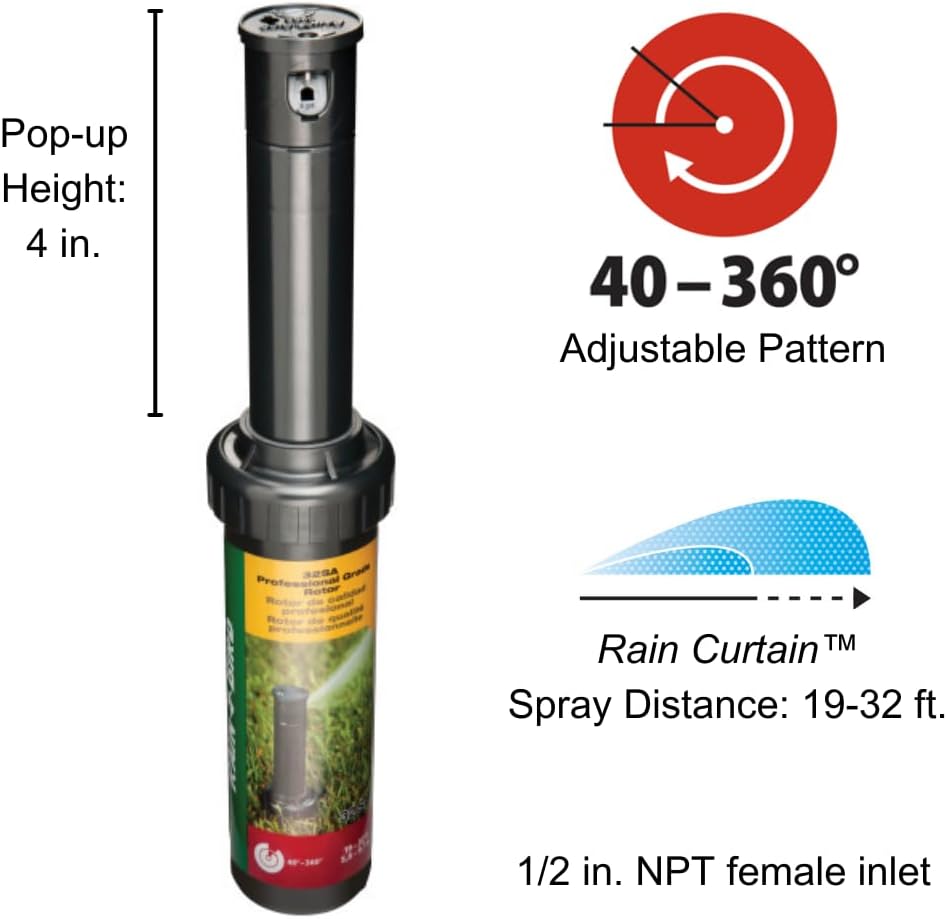
Check price on AmazonThe 32SA is Rain Bird’s brass gear-drive rotor, and it occupies a clear niche: permanent in-ground residential and light-commercial turf zones on municipal or treated water. According to the Rain Bird Corporation 32SA Series Specification Sheet, the head delivers a throw radius of 25–50 feet depending on nozzle selection. It accepts a full range of interchangeable nozzles, including Rain Bird’s matched-precipitation-rate (MPR) nozzle series — meaning you can swap nozzles to change throw distance and keep precipitation rates consistent across a zone.
The all-brass internals are the central reason buyers specify this head for long-term installs. Owners on municipal water report a roughly 5-year head lifespan as a working expectation, with some installations running longer when heads are protected from foot traffic and mowing damage. That is a meaningful number when you’re speccing 20 or more heads for a multi-zone install and trying to project replacement cycles.
The arc adjustment mechanism draws consistent praise: a flat-blade screwdriver adjustment that is clean and predictable. On a job site where you are fine-tuning coverage after heads are already in the ground, that matters. Installers pairing the 32SA with smart controllers — such as the Rachio 3 or Hunter Pro-HC — benefit from output that is consistent enough to make ET-based precipitation math reliable.
One frequently asked buyer question: can you buy replacement nozzles separately to change throw distance? The answer is yes — the 32SA accepts standard Rain Bird nozzles sold individually, which means you can dial in a shorter or longer radius without replacing the head body. This is a meaningful cost and labor advantage on established installs where one zone’s coverage needs to change.
Where the 32SA underperforms: It is the most expensive of the three heads reviewed here, and it is not the right head for well water or high-sediment sources. The brass body also does not flex on freeze-thaw stress the way plastic does — proper winterization is mandatory in freeze-climate installs.
Rain
$53.95
In stock on Amazon
Check price on AmazonRain Bird 5000 — The Volume Play for Residential and HOA Installs
Rain
$11.36
In stock on Amazon
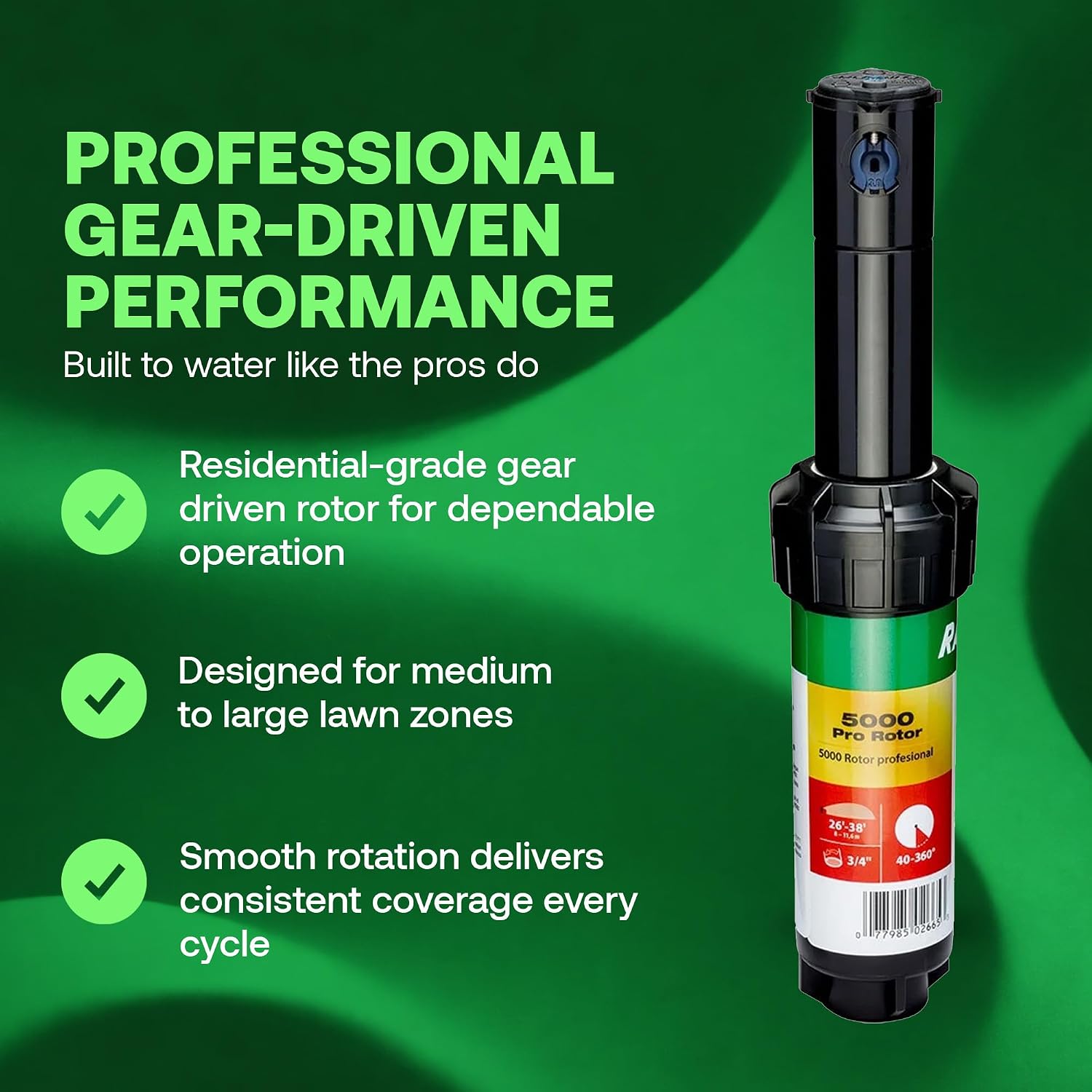
Check price on AmazonThe Rain Bird 5000 is the best-selling gear-drive rotor in the U.S. residential market. According to the Rain Bird Corporation 5000 Series Rotor Product Data, coverage runs 25–50 feet nozzle-dependent, and every 5000 ships with what installers consistently describe as a bundled nozzle tree — a rack of multiple nozzle options included in the box. For a first-time component builder or a property manager spec’ing a cookie-cutter HOA zone, that out-of-the-box flexibility is genuinely useful and reduces the separate nozzle-sourcing step that the 32SA requires.
Arc adjustment on the 5000 uses a built-in keyhole-style mechanism. The adjustment process is rated as low-fuss — the arc stays where you put it without drifting under normal operating conditions, which is exactly what you want once heads are set and buried.
The critical installation gotcha: If you are mounting a Rain Bird 5000 on a riser stake above ground — common in temporary setups, raised-bed irrigation, or when retrofitting without digging — you need a separate ½-to-¾-inch adapter fitting. It does not come in the box. This is a real-world detail that will send you back to the parts bin mid-install if you don’t plan for it. If you’re ordering online and staging a job, add that adapter to your cart at the same time as the heads.
Water quality caveat: Like all gear-drive rotors, the 5000’s internal turbine and gear mechanism make it vulnerable to iron and sediment. Installers with well water sources report the same degradation pattern documented on other gear-drive heads. The 5000 is an excellent head — on clean water.
Rain
$11.36
In stock on Amazon
Check price on AmazonRain Bird P5R — The Impact Sprinkler That Earns Its Reputation
Rain
$8.37
In stock on Amazon
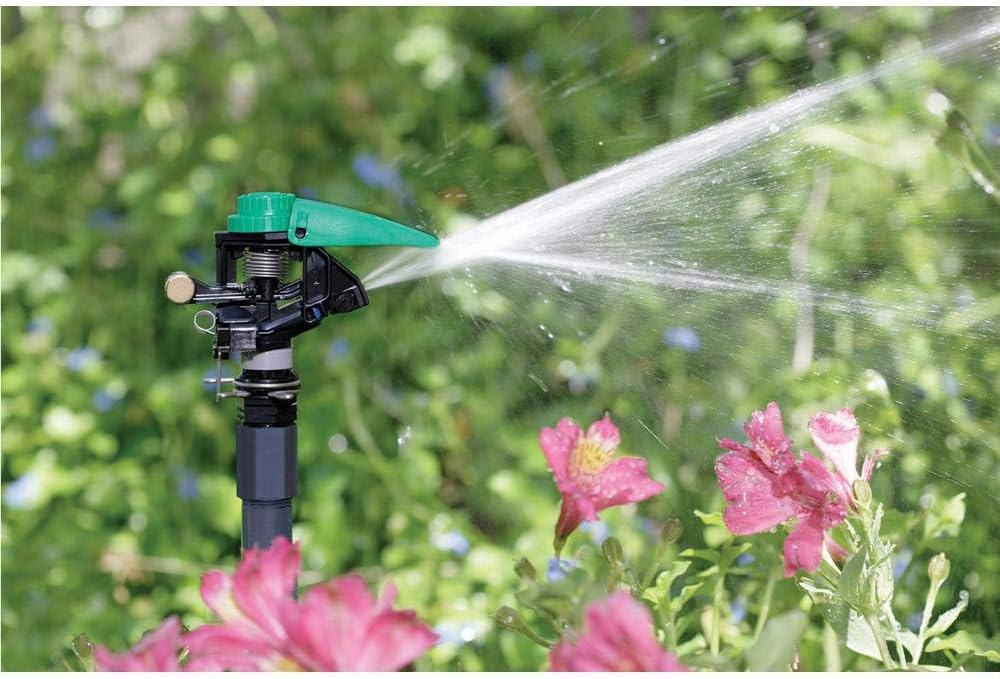
Check price on AmazonThe P5R is a plastic-body impact sprinkler, and that plastic body is the first thing skeptical buyers fixate on. The evidence from the field pushes back hard on that skepticism. Multiple installers explicitly state the P5R outperforms many brass impact clones they’ve tried, particularly under pressure variation — and they say so directly in response to the same skepticism you may be feeling right now.
Two performance notes stand out:
1. Pressure range flexibility. The P5R performs reliably at both low and high pressure — a meaningful advantage on systems where pressure varies across zones or across the day. The UC ANR Landscape Irrigation Management series (ucanr.edu) notes that impact sprinklers are generally more tolerant of pressure fluctuation than gear-drive types, and field reports on the P5R bear that out in practice.
2. Iron-ore well water compatibility. Installers with iron-ore wells identify the P5R as the only head that has worked reliably for them long-term, with gear-drive heads failing over time in that environment. According to the Rain Bird Corporation P5R Impact Sprinkler Product Data, the head’s single open-orifice design carries no internal turbine or gear passages — which is precisely why iron and sediment do not degrade it the way they degrade gear-drive mechanisms. For well-water installers, this is not a minor differentiator — it is the deciding factor.
The P5R is also worth considering for above-ground portable setups, agricultural-style applications, and situations where you need a head that tolerates rough water without constant maintenance. Its mechanical simplicity means there is very little to go wrong, and if something does go wrong, the repair is intuitive.
Where the P5R is the wrong call: If you need fine precipitation rate matching across zones managed by a smart controller doing ET-based scheduling, the impact mechanism’s output is less precisely matched than MPR gear-drive nozzles. For engineered turf zones on a controller like the Rachio 3, the 32SA or 5000 gives you tighter control. For a well-water system, a slope zone, a rougher-use application, or anywhere iron sediment is present, the P5R is the correct specification. The EPA WaterSense program (Outdoor Water Use in the United States, epa.gov) emphasizes that head selection should prioritize water-use efficiency relative to site conditions — and on a well-water site, a head that stays functional over time is the most efficient choice by any measure.
Rain
$8.37
In stock on Amazon
Check price on AmazonBy the Numbers — Quick Comparison
| Feature | Rain Bird 32SA | Rain Bird 5000 | Rain Bird P5R |
|---|---|---|---|
| Type | Gear-drive rotor | Gear-drive rotor | Impact sprinkler |
| Body material | Brass | Plastic | Plastic |
| Throw radius | 25–50 ft (nozzle-dep.) | 25–50 ft (nozzle-dep.) | Variable (pressure-dep.) |
| Nozzles included | Sold separately | Nozzle tree included | Fixed orifice |
| Well/sediment water | Not recommended | Not recommended | Field-confirmed reliable |
| Reported lifespan (muni water) | ~5 years (installer reports) | Multi-season | Not reported as a limit |
| Arc adjustment | Flat-blade screwdriver | Built-in keyhole | Spring-arm tension |
| Tier | Rain — $53.95 | Rain — $11.36 | Rain — $8.37 |
Frequently Asked Questions
1. Will a gear-drive rotor like the Rain Bird 5000 or 32SA work reliably with iron-ore or high-sediment well water?
Based on field installer reports and the Irrigation Association’s Landscape Irrigation Best Practices Guide (irrigation.org), the answer is no — not reliably over time. Installers with iron-ore wells and high-sediment water sources consistently report gear-drive rotor degradation and failure, attributed to internal turbine and gear passages clogging or corroding. For iron-ore or high-sediment well water, impact sprinklers — specifically the Rain Bird P5R — are the class of head that field experience confirms works over the long term.
2. What extra fitting do I need to mount a Rain Bird 5000 on a sprinkler stake above ground?
The Rain Bird 5000 requires a ½-to-¾-inch adapter fitting when mounting on a riser stake, and it does not come in the box. Order it at the same time as your heads to avoid a mid-install hold.
3. How long do Rain Bird 32SA heads typically last before needing replacement?
Installer reports on municipal water put the working expectation at roughly 5 years, with some installations running longer when heads are protected from mechanical damage. This figure applies to clean, treated municipal water; well water or high-mineral sources will likely shorten that cycle significantly for any gear-drive rotor.
4. Can I buy replacement nozzles separately for the Rain Bird 32SA to change the throw distance?
Yes. The 32SA accepts standard Rain Bird nozzles sold individually, allowing you to change throw distance or precipitation rate on an existing head without replacing the body. This is one of the 32SA’s practical advantages on established installs.
5. Is the Rain Bird P5R plastic impact sprinkler durable enough for a permanent in-ground install?
Yes — and the field evidence says so directly. Multiple P5R installers explicitly note that the plastic body should not deter buyers, and that it outperforms brass impact clones in real-world use. The EPA WaterSense program (epa.gov) frames outdoor irrigation efficiency in terms of matching head type to site conditions; on a site with iron-well water, a mechanically simple head that stays functional is the efficient choice. The P5R’s open-orifice design, documented in the Rain Bird Corporation P5R Impact Sprinkler Product Data, is the structural reason it survives water chemistry that defeats gear-drive rotors.
The Buying Decision
If your system runs on municipal or clean treated water and you want engineered precision for a smart-controller zone, the Rain Bird 32SA is the long-term choice. Budget for 5-year replacement cycles and stock the nozzle sizes you need separately.
If you’re doing a residential or HOA turf install on clean water and want value, speed, and the nozzle tree in the box, the Rain Bird 5000 is the workhorse. Order the ½-to-¾-inch adapter if you’re going above-ground on stakes.
If your water comes from a well, pond, or any source with iron, sediment, or high mineral content, stop right there. The Rain Bird P5R impact sprinkler is not a compromise — it is the correct specification. Installers with exactly your situation have run the experiment and reported back. Don’t repeat their early mistakes with gear-drive heads.