August 10, 2026 • Tomás Guerreiro • 9 min reading time • Specs verified June 18, 2026
When You Don't Need Smart: The Hunter X-Core and Non-WiFi Controllers That Still Outperform Cheap Smart Timers
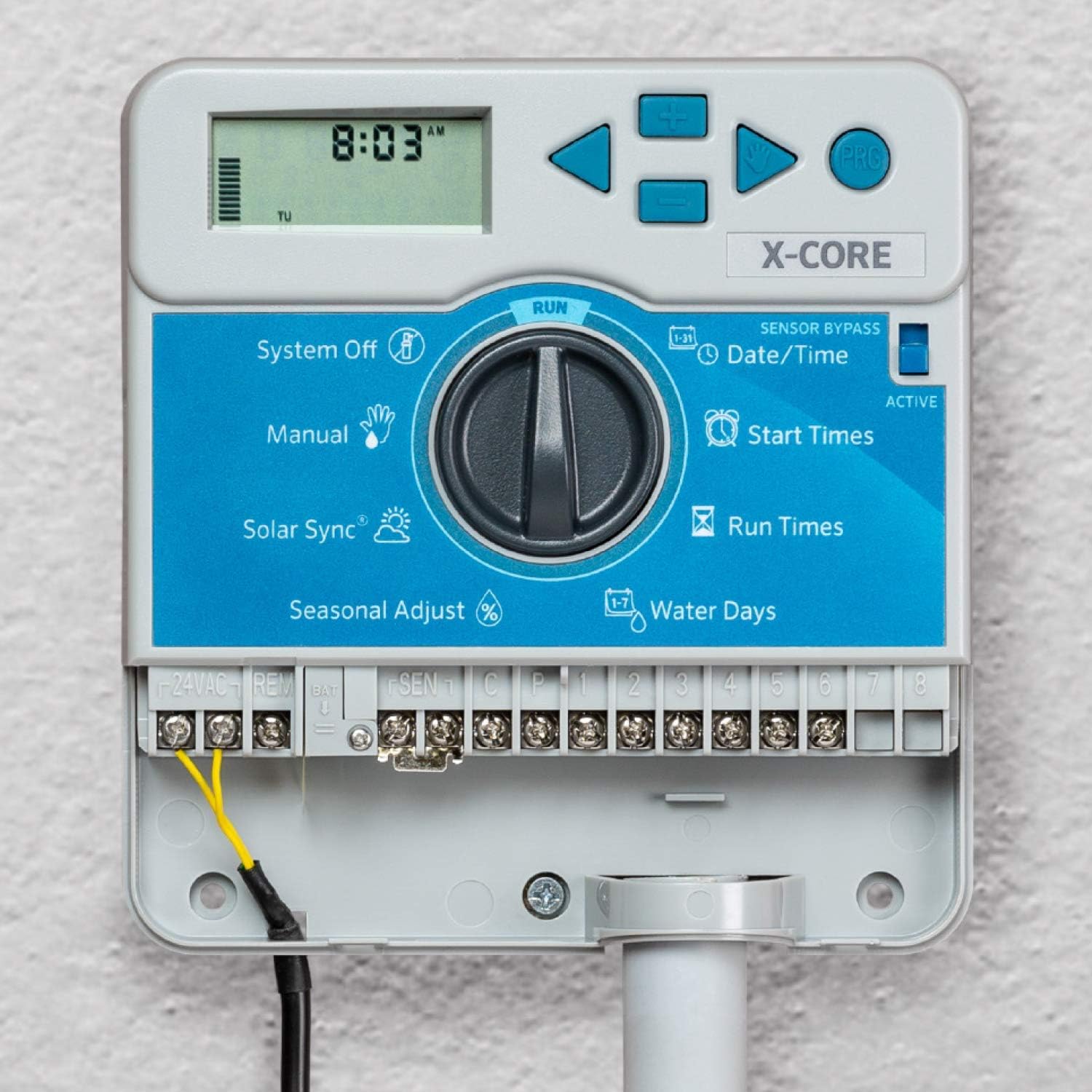
A sprinkler controller is the brain of your irrigation system — it’s the box on your garage wall that tells each zone (a group of sprinkler heads or drip emitters) when to run and for how long. For the last several years, the marketing machine has pushed hard toward “smart” controllers: WiFi-connected units that pull local weather data and automatically skip or shorten watering cycles when it rained yesterday. That’s genuinely useful technology. But it’s not the only technology that works, and for a significant slice of real-world installations, paying a $150–$250 premium for WiFi connectivity means paying for a feature that either goes unused or introduces failure points the property doesn’t need. This article is for the person staring at a 4–8 zone project who wants to make the right call — not the trendy call — on what controller to put in the wall.
The Actual Tradeoff: Connectivity vs. Reliability
Let’s name the tradeoff plainly, because product marketing won’t.
What a smart controller actually adds: Weather-based schedule adjustment (called ET-based scheduling, where ET stands for evapotranspiration — the rate at which soil and plants lose water to the air), remote access via smartphone app, flow monitoring integration on higher-end units, and usage reporting dashboards. These are real benefits on properties where someone is not on-site daily, or where the landscape is complex enough that a fixed schedule wastes meaningful water.
What a smart controller adds in failure surface: WiFi dependency, app account management, firmware update cycles, cloud service continuity risk, and a higher per-unit cost that compounds across multi-property portfolios. The EPA’s WaterSense program’s performance specification for labeled controllers notes that weather-responsive features only deliver their efficiency gains when the controller is correctly commissioned with local ET data — a step that many end users and even some installers skip entirely.
A “dumb” timer — the pejorative term the industry uses — doesn’t actually mean unsophisticated. The Hunter X-Core, Rain Bird SST series, and Orbit B-hyve’s non-connected siblings run on hardwired logic that doesn’t care whether your router is down, whether the app’s cloud backend had a service interruption, or whether a firmware update introduced a scheduling bug. UC ANR’s landscape irrigation scheduling publication makes a point that gets lost in smart-controller hype: the single biggest driver of irrigation efficiency is correct schedule design, not the sophistication of the box executing it. A well-designed program on a $120 conventional controller outperforms a lazy program on a $300 smart unit every time.
The Hunter X-Core: What the Spec Sheet Actually Tells You
The Hunter X-Core is the reference point for this category. It’s available in 4, 6, and 8-station configurations, with a 16-station expansion path, and it’s been a workhorse in the residential and light-commercial segment long enough that installers have a deep read on its reliability profile.
By the numbers — Hunter X-Core vs. a budget smart timer:
| Feature | Hunter X-Core (8-station) | Typical sub-$100 Smart Timer |
|---|---|---|
| Zones | 8 (expandable to 16) | 6–8 (usually fixed) |
| Programs | 3 independent | 1–3 (varies) |
| Start times per program | 4 | 2–4 |
| WiFi dependency | None | Required for app features |
| Street price (2026) | ~$80–$100 | $60–$120 |
| WaterSense certified | No (manual scheduling) | Sometimes |
The X-Core’s three independent programs matter more than they appear to on paper. In a real multi-zone layout, you’re often running turf zones on a different cadence than drip zones for beds — turf might run three days a week for longer cycles, while drip runs shorter and more frequently. Collapsing those into a single program forces compromises. The Irrigation Association’s best management practices document is explicit on this point: zones with different precipitation rates (how fast heads apply water, measured in inches per hour) and different soil infiltration rates should run on independent schedules, not shared start times.
Owners and installers in long-run reviews consistently describe the X-Core’s interface as “dated but bulletproof” — the dial-and-button UI is not glamorous, but it’s legible to any technician on a service call without app credentials or a manual. This Old House’s 2025 buyer’s guide notes this as a practical advantage in rental and light-commercial contexts where multiple people need to make schedule adjustments.
Where Non-Smart Controllers Win the Decision Frame
Here’s the decision rule, stated as cleanly as possible:
If X, then Y:
-
If the property is owner-occupied, has a consistent landscape routine, and the installer will commission a solid baseline schedule → A conventional controller like the Hunter X-Core, Rain Bird SST-600i, or Orbit’s hardwired timers delivers everything needed at 40–60% of the cost of a mid-tier smart unit. The money saved goes toward better valves, pressure regulation, or head upgrades — components that affect water distribution quality in ways no controller app can compensate for.
-
If the property is a rental, managed remotely, or has a landscape that changes seasonally enough that someone needs to adjust runtime from a phone → The smart controller premium is justified. This is genuinely the use case it was built for.
-
If the install budget is $200–$600 (the first-component-build tier) and the buyer is new to zone design → A conventional controller removes one failure point (WiFi commissioning) during the learning curve. Family Handyman’s installation guide for sprinkler controllers specifically calls out WiFi setup as the most common source of setup frustration for first-time installers. Get the zones right first; add connectivity later if you want it.
-
If you’re speccing across multiple properties → The math shifts hard toward conventional. At five properties, the difference between a $90 X-Core and a $250 smart controller is $800 — enough for a complete drip manifold upgrade on one site, or a reserve for a valve replacement cycle.
-
If the municipality or HOA requires a WaterSense-certified controller → Check requirements before defaulting to conventional. Some jurisdictions tie rebates or code compliance to certified smart controllers, and in that case the rebate can offset or eliminate the price premium entirely. EPA WaterSense’s controller specification list is the authoritative source to cross-reference against your local program.
The Competition in the Conventional Tier
The X-Core isn’t the only name worth knowing here.
Rain Bird SST series: The SST-600i (6-zone) and SST-900i (9-zone) are the Rain Bird equivalents — similar price band, similar independent-program logic, and a modular design that Rain Bird’s dealers favor for parts availability. Reviewers at This Old House rate the SST series as the cleaner UI of the two, though the zone expansion path is less flexible than Hunter’s.
Orbit’s hardwired timers (non-B-hyve): Orbit occupies the bottom of the conventional tier — adequate for simple 4-zone setups, but the build quality and terminal block reliability draw more complaint volume in aggregated reviews than either Hunter or Rain Bird. If you’re stepping up from a boxed Orbit kit, the smart move is stepping up to X-Core rather than lateraling to a higher-spec Orbit.
Irritrol MC-Plus: Worth naming for the light-commercial reader. The MC-Plus handles up to 12 stations and offers the kind of program flexibility (multiple independent programs, seasonal adjustment percentages by zone) that property managers with varied landscapes actually use. Street price runs $120–$160. It doesn’t get the marketing attention of Hunter or Rain Bird’s flagship lines, but installers who work across multiple brands tend to have strong opinions about its reliability record.
Toro TDDCWIRING (decoder-based systems): Outside the scope of this piece, but worth flagging: at the multi-zone commercial scale, two-wire decoder systems (where a single wire pair runs all zones, with each valve addressed digitally) represent a different architecture entirely. That’s a separate decision frame for installs above 12–16 zones.
The GPM/PSI Caveat That Never Goes Away
A controller — smart or otherwise — cannot fix a hydraulic problem. This site’s fundamental premise is that your GPM (gallons per minute) and PSI (pounds per square inch) budget is the constraint that governs every other component decision, and it applies here too.
If your service line delivers 8 GPM at the meter and your zone design tries to run $15 GPM worth of rotors simultaneously, a $400 smart controller will fail to solve that just as thoroughly as a $90 X-Core. The Irrigation Association’s best management practices document dedicates significant space to this point: controller selection comes after hydraulic zone design, not before. Sequence matters.
Measure static pressure at a hose bib (a standard pressure gauge, threaded to a hose bib, costs under $15 and takes 30 seconds). Run a bucket test on your service line to estimate flow rate. Zone your heads so no single zone exceeds 75% of available GPM. Then select a controller. In that order.
The seduction of smart controllers is partly that their feature set is highly visible and tangible — you can see the app, show it to a client, point to weather integration. The hydraulic fundamentals are invisible once the system is in the ground, but they’re what determines whether the system actually performs. UC ANR’s irrigation scheduling publication frames it this way: scheduling efficiency gains of 10–15% from weather-based controllers are real, but they’re secondary to the 20–40% efficiency losses that come from poor zone design and mismatched precipitation rates.
Buying Decision: Who Should Buy What
Buy the Hunter X-Core (or Rain Bird SST equivalent) if:
- Your install is 4–8 zones, owner-managed, with a stable landscape
- You’re spec’ing across multiple properties and want to control per-unit cost
- You’re a first-time component builder who wants to eliminate variables during commissioning
- Your jurisdiction doesn’t tie rebates to WaterSense-certified smart units
Source options: Irrigation Supply Store and IrrigationDirect both stock the X-Core at competitive street prices in the $80–$100 range for the 8-station version. Hunter’s commercial distribution network means local irrigation wholesalers (who sell to the trade without minimums in most markets) often beat online pricing on multi-unit orders.
Buy a mid-tier smart controller (Rachio 3, Hunter Pro-HC) if:
- The property is remotely managed or a rental
- Your municipality offers a rebate that closes the price gap
- You’re integrating with flow sensors and want remote shutoff capability
The smart vs. conventional decision doesn’t have a universal right answer — but it has a right answer for your specific property, budget, and operational reality. The X-Core’s continued sales volume in 2026, despite a decade of smart-controller marketing pressure, is itself a data point: operators who’ve run both tend to know which situation calls for which tool.