August 5, 2026 • Tomás Guerreiro • 12 min reading time • Specs verified June 18, 2026
Hunter MP Rotator Nozzle Family Decoded: 1000, 2000, 3000, 3500, Side Strip, and Corner Strip Compared
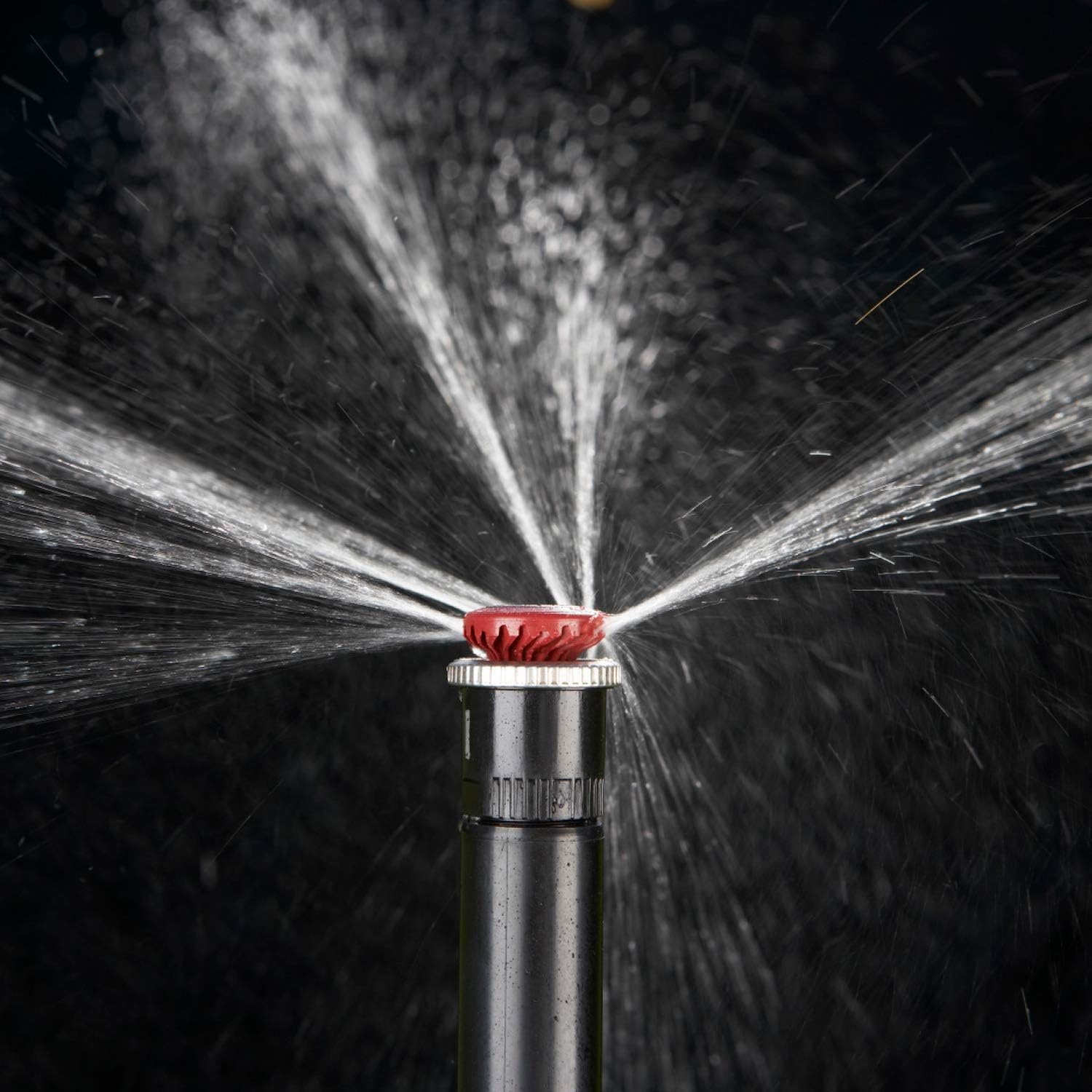
If you’ve ever watched a sprinkler head fog a driveway with mist on a windy morning, or noticed brown patches in a lawn that seems to get plenty of water, you’ve already met the problem that Hunter MP Rotators were designed to fix. A rotary nozzle — the category these belong to — works differently from a traditional fixed spray head. Instead of throwing a cone of water all at once, it delivers multiple slow-rotating streams at a very low application rate, measured in inches per hour (how fast water lands on the soil). That low, steady rate gives the ground time to absorb water before runoff starts, which is why the Irrigation Association’s Best Management Practices documentation consistently flags precipitation rate matching as the single most important factor in reducing landscape runoff. Hunter’s MP Rotator line isn’t one product — it’s a family of six distinct nozzles, each optimized for a different zone geometry. This guide decodes all of them, shows you where each one wins and where it doesn’t, and gives you honest tradeoff math so you can spec the right model the first time.
| EDITOR'S PICKHunter Sprinkler MP350090 MP Ro… | Mid-tierHunter Sprinkler MP300090 MP Ro… | Budget pickHunter MP1000-90 Adjustable Spr… | |
|---|---|---|---|
| Radius | 31–35 ft | 22–30 ft | 8–15 ft |
| Arc range | 90°–210° | 90°–210° | 90°–120° |
| Model | MP3500 | MP3000 | MP1000 |
| Color code | — | — | Maroon |
| Water-saving | — | — | ✓ |
| Price | $10.06 | $9.39 | $7.68 |
| See on Amazon → | See on Amazon → | See on Amazon → |
Why the MP Rotator Exists: The GPM/PSI Backstory
Before comparing models, understand the root engineering decision that unites this whole family. A standard fixed-spray nozzle operates at 20–30 PSI and throws water at roughly 1.3–2.0 inches per hour. MP Rotators are engineered to run at 40 PSI at the head and apply water at just 0.40–0.50 inches per hour across the full family. That’s roughly three to four times slower than a conventional spray.
The immediate consequence: your zone run times must be three to four times longer to deliver the same amount of water. This is the number-one confusion point reviewers document across the product line — homeowners install MPs, run the zone for the same 10-minute cycle they used before, and call the nozzles defective. They’re not defective. The EPA WaterSense program specifically endorses low-precipitation-rate nozzles like rotary designs because slow application dramatically reduces runoff on compacted soils and slopes. UC ANR’s landscape irrigation scheduling documentation puts it directly: matching application rate to soil infiltration rate is more important than head brand or style.
The GPM payoff: because you’re applying less water per minute, each head draws less flow from your pipe. MP Rotators pull roughly 0.15–0.39 GPM (gallons per minute) per head depending on model and arc, compared to 0.5–1.5+ GPM for a fixed-spray head covering similar area. That means you can fit more heads on a single valve zone without overloading your system’s flow budget — a genuine win on systems with tight pressure or undersized supply lines.
The Full Family at a Glance
By the Numbers
| Model | Radius (ft) | Precip Rate (in/hr) | Min. Arc | Typical GPM Range |
|---|---|---|---|---|
| MP1000 | 8–15 | ~0.40 | 90° | 0.15–0.39 |
| MP2000 | 13–21 | ~0.40 | 90° | 0.15–0.39 |
| MP3000 | 17–30 | ~0.40 | 180° practical min. | 0.15–0.39 |
| MP3500 | 25–35 | ~0.40 | 180° | 0.15–0.39 |
| MP Side Strip | 5×30 (strip) | ~0.40 | Fixed pattern | 0.22–0.28 |
| MP Corner Strip | 90° corner | ~0.40 | Fixed pattern | 0.12–0.15 |
Source: Hunter Industries MP Rotator Product Data Sheet. All figures at 40 PSI operating pressure at the head.
Model-by-Model Breakdown
MP1000 — The Short-Range Workhorse
The MP1000 covers 8 to 15 feet of radius, making it the go-to for small turf panels, courtyard strips, and tight residential zones where larger heads would overshoot into beds, walkways, or structures. Arc is user-adjustable from 90° to 210°.
Where it earns its place: Reviewers consistently describe the MP1000 saving narrow side-yard strips where a conventional pop-up would drench a fence or foundation wall. It also shines in low-pressure situations — because it operates efficiently down to about 25 PSI at the head, it’s forgiving of systems where pressure drops across long runs.
Honest limitation: At the minimum 8-foot radius, you’re committing to tight head spacing. Head-to-head coverage (each head’s throw reaching the adjacent head) requires spacing at no more than the rated radius, so an 8-foot minimum radius means heads no more than 8 feet apart on a triangular layout. That’s a lot of heads for a large zone.
MP2000 — The Mid-Range General Purpose
Radius 13–21 feet, arc 90°–210°. This is the model most installers reach for first on standard residential turf zones. It bridges the gap between the tight geometry of the 1000 and the longer throws of the 3000, and it’s the easiest to spec for typical 15×15 to 20×20 foot turf panels.
The practical case: Colorado State University Extension’s turfgrass irrigation guidance recommends head spacing equal to or less than the nozzle’s radius under average wind conditions. The MP2000’s 13–21 foot range means you can space heads 13 feet apart on worst-case days and 18–20 feet on calm days — practical geometry for most suburban lots.
Watch for: Like all MP models, it needs the companion MPtool (Hunter’s proprietary plastic adjustment key) to set arc accurately. More on that tool below.
MP3000 — The Arc Adjustment Controversy
Radius 17–30 feet, and this is where the documented buyer frustration lives. The spec sheet lists arc adjustment from 90° to 210°, but across aggregated reviews, a consistent pattern emerges: the 90° minimum is extremely difficult to achieve in practice. Multiple buyers report the silver adjustment ring rotating freely without meaningfully locking below 180°. Hunter’s own installation documentation acknowledges that the design is optimized for full-circle and half-circle patterns, and several contractors in long-run reviews note they treat the MP3000 as a 180°-minimum nozzle in practice.
This is not a defect in the traditional sense — it’s a geometry constraint that the spec sheet doesn’t adequately warn against. If your application genuinely needs a 90° arc, the MP2000 is the more reliable choice. If you’re covering large open turf in half- or full-circle patterns at 20–30 feet, the MP3000 delivers excellent results and reviewers consistently rate distribution uniformity as a strength.
Decision rule: If the zone corner requires less than 180°, spec down to an MP2000. If you’re covering large, open turf where 180°+ arcs are the norm, the MP3000 is the right choice.
MP3500 — Long Range, Maintenance Required
Radius 25–35 feet makes the MP3500 the longest-throw member of the family — suitable for parks, large turf panels, sports fields, or any situation where fewer heads covering more ground is the economic and hydraulic goal. Arc adjusts 180°–360°.
The calcium clogging reality: Owners who run the MP3500 in areas with hard water (high mineral content) report clogging of the nozzle’s internal orifice with calcium deposits over extended runtime — particularly at long cycle times. This isn’t a flaw unique to Hunter, but the MP3500’s tight internal tolerances make it more susceptible than lower-precision fixed sprays. The fix is straightforward: remove the nozzle body, soak in a diluted white vinegar solution for 30–60 minutes, and flush with clean water before reinstalling. Hunter Industries’ maintenance documentation recommends quarterly visual inspection of nozzle orifices in hard-water regions. A proactive schedule beats an emergency service call on a commercial property.
Spec consideration: At 35-foot radius, head-to-head spacing means heads are a long way apart. On windy sites, wind drift at this throw distance can meaningfully reduce distribution uniformity — Colorado State Extension’s wind adjustment guidelines recommend reducing spacing by 20–30% in areas with consistent winds above 10 mph.
MP Side Strip and Corner Strip — The Unsung Problem Solvers
These two are the reason countless homeowners describe “the end of driveway overspray problem” disappearing. Fixed patterns, not adjustable arcs.
MP Side Strip covers a fixed rectangular pattern roughly 5 feet wide by 30 feet long. It’s engineered specifically for narrow strips — the stretch of turf between a sidewalk and curb, a side yard bounded by fences, or a median strip. Reviewers who install it in these applications describe it as the only nozzle that actually solved the pattern without misting across pavement. It requires no arc adjustment and mounts on any standard nozzle-compatible pop-up body.
MP Corner Strip covers a 90° corner pattern, designed to sit at the corner of a rectangular strip and fill the section that a Side Strip head can’t reach without overshooting. The two are designed to be used together — Side Strip handles the long runs, Corner Strip handles the end caps.
The combined case: A typical sidewalk strip installation uses MP Side Strip heads spaced 25–30 feet apart down the length, with MP Corner Strips at each end. No misting, no overspray, matched precipitation rate across the entire strip. Owners in aggregated reviews consistently describe this pairing as the single biggest improvement they made to strip irrigation.
The MPtool: Not Optional, Not Replaceable
Arc adjustment on every MP Rotator model uses a proprietary hex-key-style slot on the nozzle collar. A regular flathead screwdriver physically fits in some cases, but owners consistently report slipping, imprecise adjustments, and rounded slots when they try. The MPtool’s geometry is matched to Hunter’s nozzle design — it seats positively, allows fine adjustment, and protects the slot from damage.
Reviewers who call it “essential” aren’t being promotional. They’re describing what happens when you try to adjust 20 nozzles across a commercial property without one — stripped slots, inaccurate arcs, callbacks. It’s a low-cost item that belongs in every installation kit.
Mixing Models: What You Can and Cannot Do
Can you mix MP1000 and MP2000 on the same zone? Technically yes — they share the same precipitation rate (~0.40 in/hr), which means they apply water at the same speed even though they cover different radii. The Irrigation Association’s matched precipitation rate principle is satisfied. But radius mismatch means some areas get head-to-head coverage and others don’t — you end up with uniformity problems not from application rate, but from coverage gaps. The rule: match your zone’s head spacing to one model’s radius. Mix models only when a zone’s geometry genuinely requires both a short-range corner head and a mid-range center head, and you’ve confirmed the coverage geometry works on paper first.
Can you mix MP Rotators with fixed sprays on the same zone? No. The application rates are incompatible — fixed sprays will over-water while MPs under-water (or vice versa) on any shared run time. Zone separation by nozzle type is non-negotiable.
Do MP Rotators Fit Rain Bird 1800 Bodies?
Yes. This comes up constantly in reviews and the answer is consistently confirmed by installers: Hunter MP Rotators use the standard female threaded connection compatible with Rain Bird 1800 series pop-up bodies, as well as most other brands’ nozzle-compatible pop-up bodies. They are not Hunter-body-exclusive. This makes them a practical retrofit option for existing Rain Bird systems where you want to upgrade nozzle performance without replacing bodies.
Frequently Asked Questions
Do Hunter MP Rotator nozzles fit Rain Bird 1800 series pop-up bodies, or only Hunter bodies? They fit Rain Bird 1800 series bodies and most other standard pop-up bodies — Hunter MP Rotators use the industry-standard threaded nozzle connection. Retrofitting an existing system with MP nozzles without changing bodies is a documented, common practice.
Why does my MP rotator zone need to run so much longer than my old fixed spray zone? MP Rotators apply water at roughly 0.40–0.50 inches per hour. Most fixed spray heads apply water at 1.3–2.0 inches per hour. To deliver the same amount of water to your turf, your run time needs to be three to four times longer. This is by design — the slower rate reduces runoff. It’s the most common installation surprise documented in owner reviews. Adjust your controller’s zone runtime accordingly, and verify your application rate with a can test (place straight-sided cans in the zone, run it, measure depth).
Can I really not get the arc below 180 degrees on the MP3000 — is that a defect? The spec sheet says 90°, but aggregated owner reviews and contractor reports consistently indicate the MP3000’s arc adjustment is unreliable below 180° in practice. The silver adjustment ring may rotate without locking at lower arcs. This appears to be a design and manufacturing tolerance issue, not an isolated defect. If you need a reliable 90° arc, spec the MP2000 instead. For half- and full-circle applications, the MP3000 performs as rated.
What causes MP3500 nozzles to clog, and how do I clean them? The most common cause in owner documentation is calcium carbonate buildup from hard water — mineral deposits accumulate in the narrow nozzle orifice over time, particularly with long run times. Clean by removing the nozzle, soaking in diluted white vinegar (1:3 vinegar to water) for 30–60 minutes, then flushing with clean water. A soft brush can clear residue from the orifice face. In hard-water regions, make this a quarterly maintenance step.
Do I need the Hunter MPtool, or can I adjust arc with a regular screwdriver? Reviewers and contractors who tried a regular screwdriver report slipping, imprecise adjustments, and damaged nozzle slots. The MPtool is designed specifically for the MP Rotator adjustment interface. It’s inexpensive and prevents damage that would require nozzle replacement. Treat it as part of the installation kit, not an accessory.
Can I mix MP1000 and MP2000 nozzles on the same valve zone? They share the same precipitation rate, so water application speed is compatible. However, coverage geometry rarely works cleanly when you mix models — radius differences create gaps or overlaps. Mix only when zone geometry requires it, and verify coverage on paper first. Never mix MP Rotators with fixed spray heads on the same zone — the precipitation rates are incompatible.
Buying Decision Framework
If your zone is small turf panels under 15 feet in radius: MP1000 is the call. Don’t overspec radius just because a larger model looks more capable.
If your zone is standard residential turf, 13–21 foot spacing: MP2000. It’s the workhorse model with reliable arc adjustment across the full stated range.
If your zone is large open turf at 20–30 feet and you’re running 180°+ arcs: MP3000 performs as rated. Don’t spec it for tight corners.
If you’re covering large turf panels on commercial or park-scale properties and can tolerate a maintenance schedule: MP3500, paired with a proactive nozzle cleaning program in hard-water areas.
If your problem is a narrow strip alongside pavement: MP Side Strip and MP Corner Strip together. This pairing has one of the strongest consensus approval ratings in the rotary nozzle category for that specific application.
Regardless of model: Add the MPtool to your order. It costs almost nothing and saves you from stripped nozzles and callback service calls.