August 20, 2026 • Tomás Guerreiro • 10 min reading time • Specs verified June 18, 2026
Hose-Bib Timer Reliability: RAINPOINT, Meross, and Rachio Smart Hose Timer After the First Season
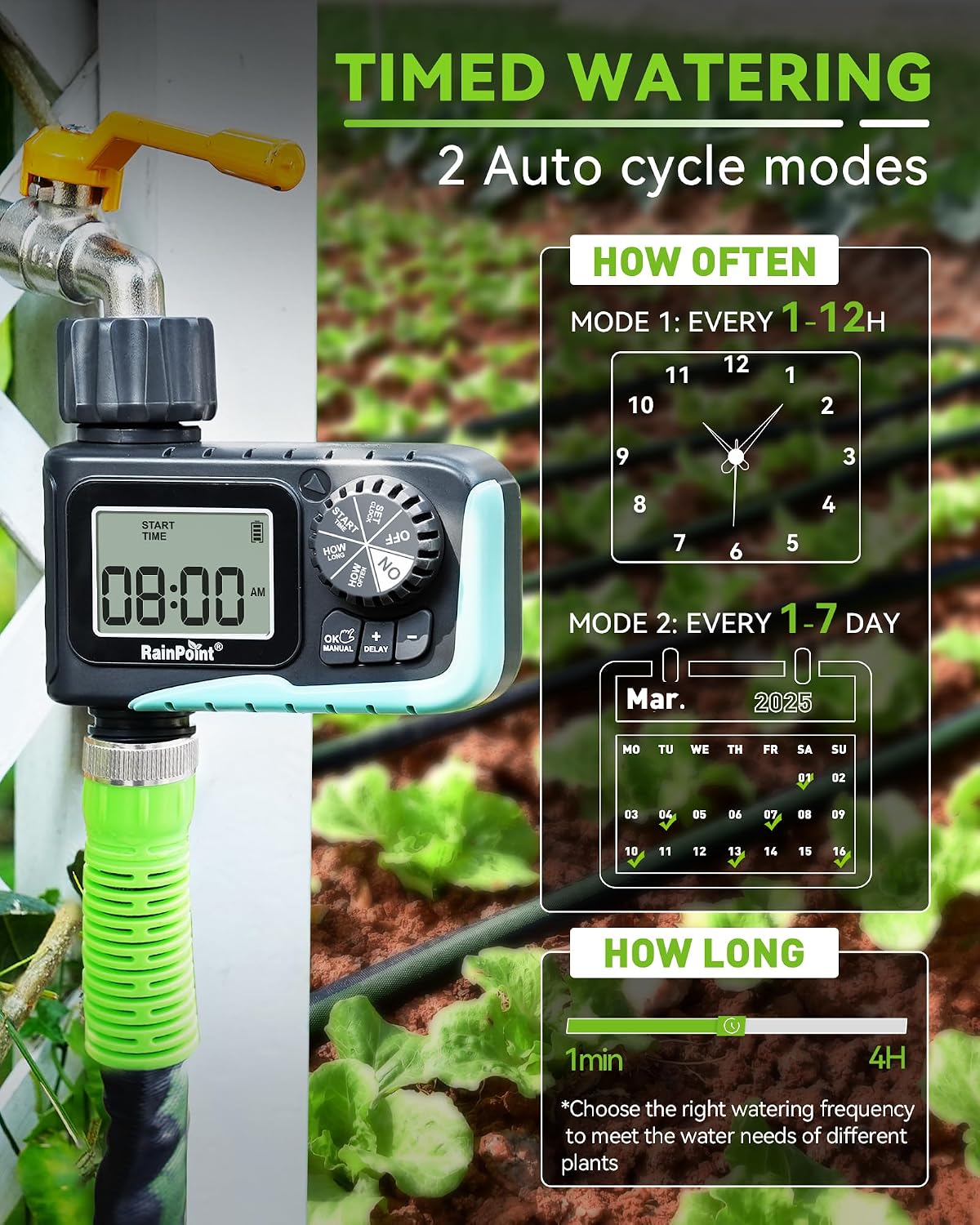
A hose-bib timer (also called a hose-end timer or tap timer) is a small battery- or WiFi-powered valve that threads directly onto your outdoor spigot and waters your garden on a set schedule — no digging, no permits, no pressure to commit to a full in-ground system. For renters, container gardeners, or anyone running a supplemental drip zone off a hose bib, they are an appealing middle ground between a manual hose and a permanent irrigation system. But there’s a pattern worth knowing before you buy: many smart hose timers earn glowing first-month reviews and quietly deteriorate by month 18 or 24. This article synthesizes long-run owner feedback across three brands — RAINPOINT, Meross, and Rachio — to map exactly where things go wrong and give you a clear decision frame before you spend $40 to $150 on something that may not survive two winters.
If you already know what a solenoid valve is and you’ve set up a smart irrigation controller before, the on-ramp section is behind you. The rest of this piece is written in practitioner mode: named tradeoffs, real failure modes, and a direct “if X, then Y” buying framework at the end.
The Two-Year Failure Cliff: What’s Actually Breaking
The most consistent pattern across aggregated owner reviews of smart hose timers is what’s been called the two-year failure cliff — a disproportionate number of units dying within a few weeks of the 24-month mark, often right as the warranty expires.
Consumer Reports’ 2024 smart-home device longevity study notes that battery-operated solenoid valves in outdoor environments face compounding stress from UV exposure, thermal cycling, and mineral buildup that most manufacturers do not fully account for in their IP ratings. Two culprits dominate the failure reports:
1. Solenoid valve fatigue. The valve — the electromechanical component that actually opens and closes to let water through — cycles hundreds of times per season. Over two years of twice-daily watering, that’s 1,400-plus open-close cycles, often under full residential water pressure (40–80 PSI). Solenoid seals and diaphragms in hose-end units are rarely serviceable; when they degrade, you get either a valve that won’t fully close (wasted water, dead lawn section) or one that stops opening at all (dead zone).
2. Battery chemistry and contact corrosion. Even “waterproof” units have battery compartments that breathe during temperature swings. Condensation breeds corrosion on the battery contacts, which causes erratic behavior long before the alkaline cells are actually depleted. Owners across all three brands report replacing batteries and finding corroded terminals that no fresh battery can overcome.
The Irrigation Association’s residential best practices documentation recommends removing hose-bib-mounted hardware before first frost and storing it dry — a step many owners skip, and one that likely explains why freeze-thaw cycles accelerate the two-year failure pattern in cold climates.
RAINPOINT: The Proactive Warranty Play (and the Weather Integration Caveat)
RAINPOINT has built a reputation in the sub-$60 segment that is, frankly, unusual for budget smart irrigation hardware: proactive warranty service. Multiple long-run owners report that RAINPOINT’s customer support reached out unprompted after a failure was flagged — even when the unit was past its stated warranty window — and shipped replacement units without requiring the customer to initiate a return. In 2025–2026, when most smart-home brands have automated their support into near-uselessness, this is called out repeatedly and specifically in owner reviews as a differentiating factor.
The RAINPOINT 2-Zone WiFi Timer receives consistent praise for fast app setup and flexible scheduling logic. The app allows independent programming of each zone, adjustable run times down to the minute, and manual override. That’s a lot of functionality for the price tier.
The documented weakness: local weather forecast integration is unreliable. At least one owner running the unit through a full season reported the weather-based rain delay feature triggering unnecessary delays based on forecast data that didn’t match actual conditions — skipping irrigation on dry days because rain was predicted and never arrived. This isn’t a flaw unique to RAINPOINT; the EPA WaterSense program’s guidance on smart controllers notes that “forecast-based” rain skip logic is meaningfully less accurate than sensor-based logic that reads actual precipitation at the site. If you care about precision water management, a physical rain sensor is a better investment than any app-based forecast skip feature.
Bottom line on RAINPOINT: Buy it knowing the hardware has a probable 24-month useful life. The warranty service behavior partially offsets this — but plan to replace, not repair.
Meross: Brass Fittings and HomeKit, but Watch the Valve
The Meross Smart Water Timer earns consistent praise on two fronts: brass fittings (a meaningful durability upgrade over the plastic threads common in this price tier) and native Apple HomeKit support without requiring a separate hub or bridge device. For anyone already running a HomeKit household — automations, scenes, Siri control — the Meross integrates cleanly in a way that most competitor units do not.
The failure mode is more alarming than RAINPOINT’s gradual decline: at least one owner reported a valve-stays-open failure within a few months of installation. The solenoid stopped receiving the close signal reliably, and the valve remained partially or fully open between scheduled cycles, running water continuously until the owner noticed a spike in their water bill. This is the worst-case scenario for any irrigation component — silent waste, not loud failure.
This Old House’s roundup of hose-end timers flags valve seal quality as the key differentiator between premium and budget units, specifically noting that thin diaphragm seals under continuous pressure eventually conform to an open position and lose the ability to fully seat. The Meross units reviewed appear to be susceptible to this under conditions of sustained high residential pressure (above 60 PSI).
If your hose-bib runs above 60 PSI, add a pressure reducer before any hose-end timer. Family Handyman’s guides on outdoor faucet management note that unregulated residential pressure is one of the most common causes of accelerated solenoid wear in hose-mounted devices — and it’s a $15 fix.
Bottom line on Meross: Strong ecosystem integration for HomeKit users. Brass fittings are a real advantage. But the valve-stays-open failure mode means you should set a water-usage alert in your utility app and check the unit weekly in the first 90 days.
Rachio Smart Hose Timer: Premium Price, Honest Limitations
The Rachio Smart Hose Timer is the most expensive unit in this comparison by a significant margin, and owners who deploy three or more of them together are consistently enthusiastic — the app experience, scheduling granularity, and integration with the broader Rachio ecosystem are best-in-class at the hose-end tier.
But the flow detection feature is where the Rachio’s marketing and real-world performance diverge most visibly. Flow detection — the ability to measure how many gallons per minute are moving through the valve and flag anomalies — is prominently marketed as a water-saving intelligence layer. In practice, at least one owner who exhausted every troubleshooting step (new batteries, pressure check, firmware update, filter cleaning, hub re-pairing) was unable to get reliable flow readings. The feature worked intermittently, not consistently, and Rachio support was unable to resolve it.
This matters because flow detection is often the reason a practitioner-level buyer chooses the Rachio over cheaper alternatives. If you’re speccing three units across a property and building automations around flow anomaly alerts, an unreliable sensor undermines the entire logic.
By the Numbers
| Unit | Approx. Price Tier | Native Smart Home | Flow Detection | Typical Failure Mode |
|---|---|---|---|---|
| RAINPOINT 2-Zone WiFi | Budget ($35–$60) | Alexa, Google | No | Solenoid fatigue ~24 months |
| Meross Smart Timer | Mid ($45–$70) | HomeKit, Alexa, Google | No | Valve-stays-open (pressure-related) |
| Rachio Smart Hose Timer | Premium ($80–$150) | Rachio app, Alexa | Yes (unreliable) | Flow sensor inconsistency |
Prices reflect 2026 market conditions; verify current pricing at point of purchase.
Decision Framework: If X, Then Y
If you’re running HomeKit automations and want native integration without a hub: Meross is the most direct path. Add a pressure reducer and set a water-usage alert. Accept that you’re buying a 2–3 year component, not a permanent installation.
If you need two independent zones on a single bib and your primary concern is budget + warranty support: RAINPOINT 2-Zone WiFi is the defensible choice. The proactive warranty behavior is real and documented. Plan for replacement at 24 months and budget accordingly.
If you’re deploying three or more units across a property and the app ecosystem matters: Rachio is worth the premium — if you do not depend on flow detection as a core feature. Use it for scheduling intelligence and remote access. Don’t build automations around the flow sensor until Rachio demonstrates consistent firmware resolution of the known sensor issues.
If your hose bib runs above 60 PSI: Install a pressure reducer before any unit from this list. This is not optional. It is the single most effective thing you can do to extend valve life across all three brands.
If you’re in a climate with hard freezes: Remove and store every hose-end timer before first frost, regardless of IP rating. Per Family Handyman’s winterization guidance, freeze-thaw cycling inside a solenoid casing is a primary driver of early failure — and it voids most warranties as “improper use.”
Frequently Asked Questions
Does the Rachio Smart Hose Timer require the WiFi hub to run scheduled programs, or just for remote access? The hub (Rachio’s bridge device, sold separately) is required for WiFi connectivity and remote access, but scheduled programs stored on the device will run locally without the hub present. Think of it the same way you’d think of a smart controller with local schedule storage — the hub enables app control; the valve runs the program independently.
Why do smart hose timers seem to fail at the two-year mark, and is this a battery or valve issue? Both, compounding each other. Solenoid diaphragms fatigue under repeated pressure cycling. Battery contact corrosion degrades signal delivery. And UV exposure degrades plastic housings. Consumer Reports’ device longevity research suggests two years is a realistic useful-life expectation for most hose-end smart timers at current price points, particularly in climates with significant temperature swings.
How reliable is flow detection on the Rachio Smart Hose Timer in real-world conditions? Based on aggregated owner reviews, inconsistently. Multiple owners report the feature working well initially and degrading over time or never resolving despite full troubleshooting sequences. It’s a capable feature in ideal conditions; treat it as supplemental, not mission-critical.
Does the Meross timer work with Apple HomeKit without a separate hub? Yes. Meross integrates natively with HomeKit via local WiFi — no Meross hub, no HomeKit hub required beyond a standard Apple Home hub (HomePod mini, Apple TV, or iPad set to home hub mode, which most HomeKit users already have).
What should I do if my hose-bib timer valve stops closing fully? First, check water pressure — if it exceeds 60 PSI, add a pressure reducer. Second, clean the inlet filter screen, which can trap debris and prevent full valve seating. Third, run a manual open-close cycle through the app to clear any stuck solenoid. If none of these resolve it, the diaphragm seal has likely conformed to an open position and the unit needs replacement. There is no field repair for a failed hose-end solenoid diaphragm.
Can RAINPOINT timers be winterized and reinstalled, or do freeze-thaw cycles accelerate failure? They can and should be removed for winter. RAINPOINT’s documentation does not rate any of its current hose-end units for freeze conditions. Owners who store their units dry indoors during the off-season report meaningfully better longevity than those who leave them installed. The Irrigation Association recommends complete removal, battery extraction, and dry indoor storage as standard winterization practice for all hose-end timers — and it’s the single best thing you can do to push past the two-year failure cliff.