August 6, 2026 • Tomás Guerreiro • 11 min reading time • Specs verified June 18, 2026
Hose-Bib Timer Longevity: What Happens After Year One With RAINPOINT, Meross, and Rachio
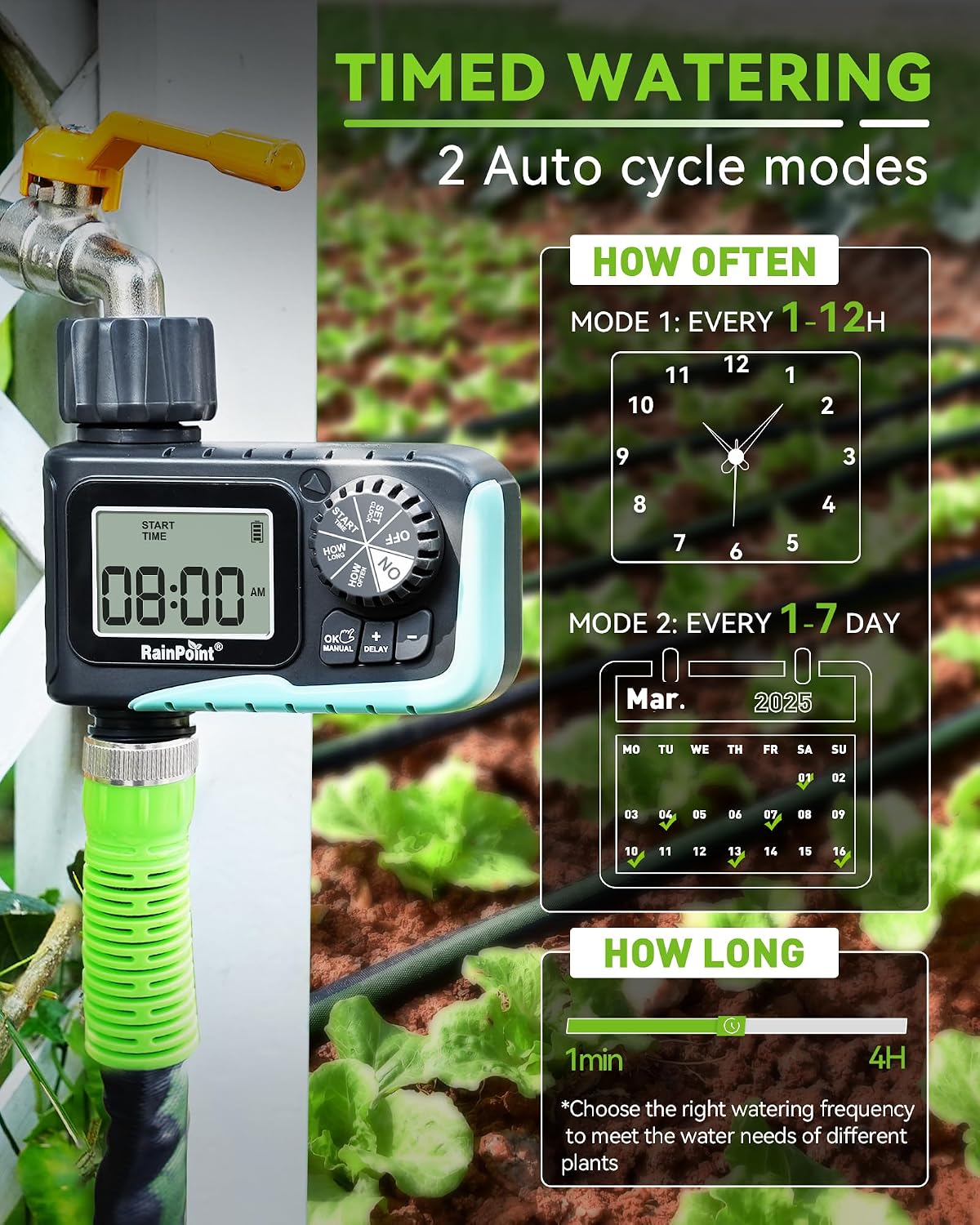
A hose-bib timer — sometimes called a hose-end timer or tap timer — is a battery-powered device that screws onto your outdoor spigot and automatically opens and closes the water flow on a schedule you program. They’re the entry point for anyone who wants automated watering without trenching a single inch of yard. For a first-time buyer, the pitch is simple: set a schedule, swap the batteries once a year, done. But owners who live with these devices past the 12-month honeymoon period tell a more complicated story — one involving valve failures that leave water running unattended, unreliable smart features that contradict the marketing, and a warranty experience that can either rescue or ruin a brand relationship. If you’re deciding between the RAINPOINT WiFi timer, the Meross Smart Water Timer, the Rachio Smart Hose Timer, and the Orbit B-hyve XD 4-Port, this breakdown is for the reader who’s already past the unboxing video and wants the two-year picture.
The Two-Year Failure Cliff: What Long-Run Reviewer Patterns Actually Show
The most underreported signal in long-run hose timer reviews is that many battery-powered units appear to cluster their failures somewhere between 18 and 30 months — call it the two-year cliff. Mechanical solenoid valves are under constant pressure cycling, UV exposure, and mineral stress from tap water. None of that stress shows up in a 90-day return window.
RAINPOINT WiFi Timer: Reliable Hardware, Exceptional Warranty Culture
RAINPOINT reviewers document the failure pattern explicitly. One long-run reviewer noted that both units from a dual-pack died at almost exactly the two-year mark — a timeline consistent enough to feel systematic rather than coincidental. What redeems the brand is the warranty response: RAINPOINT proactively replaced the units a full year outside the stated warranty period, with no escalation required beyond a support contact. That reviewer updated their rating to five stars.
For a product category where every brand’s hardware is roughly equivalent silicon and solenoid engineering, that support culture is genuinely differentiating. This Old House, in their buyer’s guide to the best hose-end timers, notes that after-sale support responsiveness is increasingly cited as a top satisfaction driver in this category — more so than raw feature counts. If reliability with a low-friction safety net is your primary goal, RAINPOINT earns consideration on warranty culture alone.
RAINPOINT
$26.99
In stock on Amazon
Check price on AmazonMeross Smart Water Timer: A Stuck-Valve Problem Worth Taking Seriously
Meross reviewers describe a different failure mode, and it’s the one worth flagging most prominently for cost and safety reasons: the valve stops closing. Water runs continuously, undetected, until the owner notices standing water, a spike in their water bill, or a downstream alert. The EPA WaterSense program, in their outdoor water use fact sheet, notes that outdoor water waste already accounts for roughly half of all residential water use — a stuck-open valve compounds that problem directly and invisibly.
Multiple independent reviewers describe a disconnect between the controller display (which still reads “scheduled off”) and the physical valve state (which is fully open). This isn’t universal across all units, but it appears in enough independent accounts to constitute a documented failure mode rather than a one-off defect. If a continuous-run failure would cause meaningful damage — a raised bed against a foundation, a deck planter, a basement-adjacent garden — this failure mode makes Meross a poor fit for those placements regardless of price.
Orbit
$77.20
In stock on Amazon
Check price on AmazonRachio Smart Hose Timer: Brand Equity That Doesn’t Fully Transfer
Rachio’s brand equity comes from their multi-zone in-ground controllers — the Rachio 3 has a well-established reputation among serious DIY irrigators. Reviewers who expected that reputation to transfer to the hose-bib entry point are mixed. One particularly detailed account walked through every troubleshooting step in Rachio’s support documentation to resolve a flow detection issue, then concluded the flow sensor reading was still unreliable after a full reset cycle.
The Irrigation Association, in their Smart Irrigation Month consumer resources, emphasizes that flow sensing is only useful when baseline calibration is accurate and consistent. Reviewer accounts suggest Rachio’s implementation in the hose-bib timer doesn’t consistently meet that bar — even if the in-ground controller line does. Long-run warranty data for the Rachio Smart Hose Timer is also thinner than for RAINPOINT, partly because the hose timer is a newer SKU in a brand known for something else. The practical recommendation: if you’re in the Rachio ecosystem, this timer works well as schedule-based automation with app convenience — but don’t depend on flow detection for anything operationally critical.
Orbit
$129.98
In stock on Amazon
Check price on AmazonOrbit B-hyve XD 4-Port: When the Software Is the Failure
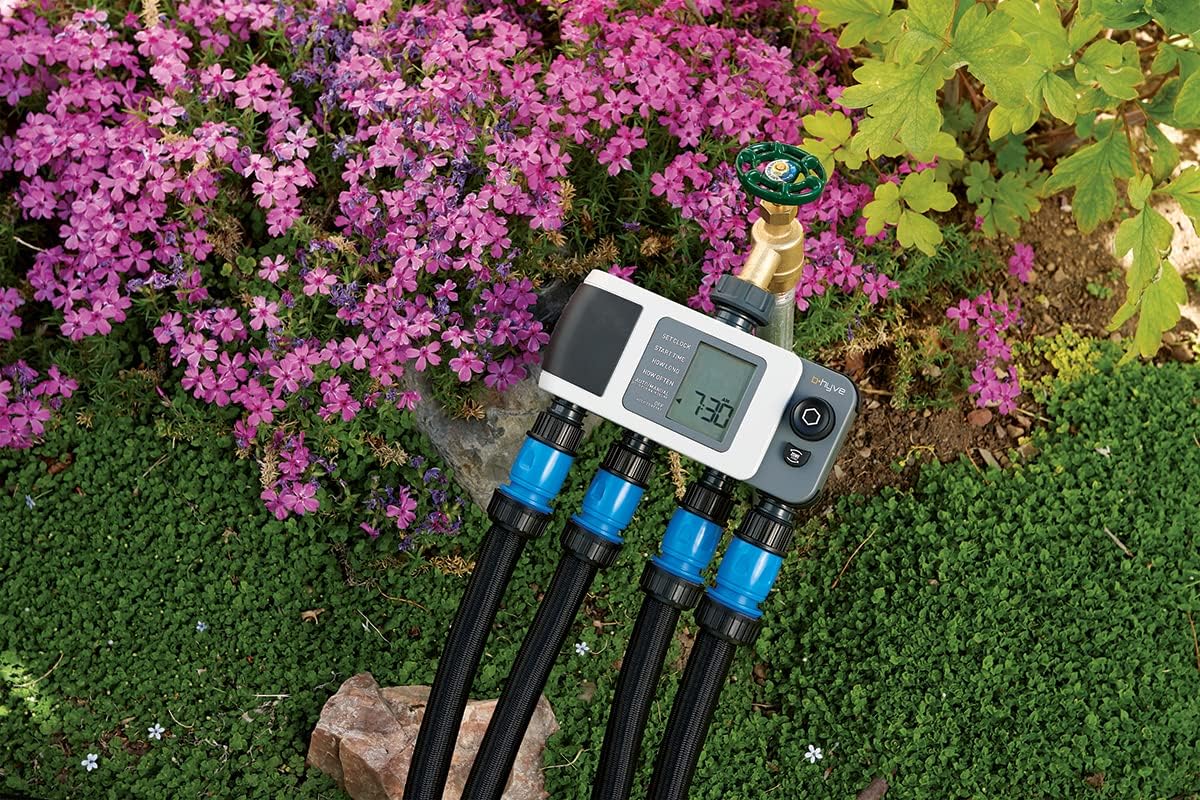
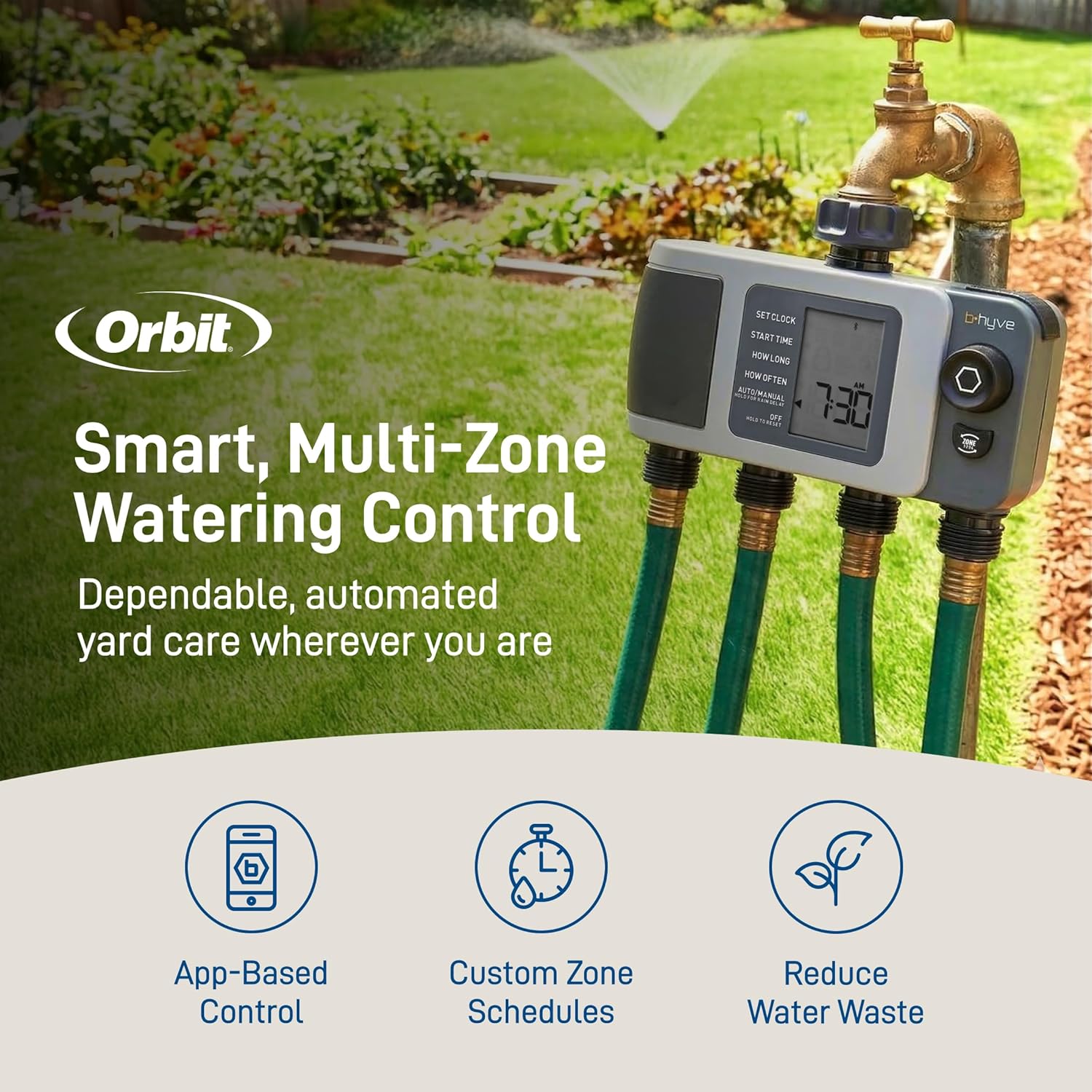
The Orbit B-hyve XD 4-Port is worth examining separately because it’s the natural “step up” choice for anyone who needs multiple zones from a single spigot. Four independently controlled ports sounds like a legitimate multi-zone solution without in-ground wiring. But long-run reviewer patterns tell the story of a product where the physical hardware is functional and the software integration is the actual product — and that software has a reliability problem.
One detailed reviewer described a troubleshooting loop that became the primary activity associated with the device: app timeouts mid-schedule, display errors requiring full resets, connectivity drops that weren’t flagged to the user, and more cumulative time spent diagnosing the system than the system spent actually watering plants. That experience captures a failure mode spec sheets don’t anticipate — a device that works but requires active management to keep working.
Family Handyman, in their guidance on how to choose a garden hose timer, notes that WiFi-dependent devices in this category are disproportionately reviewed negatively not because the hardware fails outright, but because the connectivity layer introduces a complexity burden that battery-only timers simply don’t carry.
The decision frame here is direct: if your use case is single-zone schedule-and-forget watering, the B-hyve XD’s four-port capability is feature bloat you’ll pay for in setup time. If you genuinely need four independently scheduled zones, the software reliability gap means you’ll spend more time managing the system than a basic timer would require. For anything beyond four zones or more than 50 feet of hose run, the Irrigation Association’s guidance on zone planning suggests the cost-benefit math typically favors a basic in-ground zone with a 24VAC valve over stacking hose-bib hardware.
By the Numbers: Quick Failure-Mode Reference
| Brand | Primary Reported Failure Mode | Warranty Response (Reviewer-Reported) | Smart Feature Reliability |
|---|---|---|---|
| RAINPOINT | ~24-month solenoid failure | Proactive replacement beyond warranty window | Rain delay accuracy mixed (see FAQ) |
| Meross | Valve stops closing — continuous run | Standard RMA; no proactive reports documented | App control generally functional |
| Rachio Smart Hose Timer | Flow detection unreliable per detailed reviewers | Thin long-run data; newer SKU | App solid; sensor data disputed |
| Orbit B-hyve XD 4-Port | App-to-hardware communication timeouts | Not widely documented | Multiple reviewers report setup frustration |
The Warranty-as-Differentiator Argument
Most comparison articles skip this section, and it’s where intermediate buyers make the most expensive mistakes. When you’re buying a device with a documented 24-month failure pattern, warranty terms and — more importantly — the support culture behind them become a core part of the value proposition.
RAINPOINT’s proactive replacement response (replacing units a year outside warranty, without the customer escalating) is a meaningful signal. It suggests a support operation that treats long-run customer relationships as worth investing in, not just a cost center minimizing liability exposure. That’s not guaranteed to repeat on your specific ticket, but the pattern across reviewers is consistent enough to be informative.
Rachio’s controller-line reputation is real and well-earned. It simply doesn’t automatically extend to a hose-bib product with a different engineering profile and a younger installed base. This Old House’s hose-end timer coverage reflects this nuance — brand prestige from one product tier doesn’t guarantee equivalent reliability in a different category.
The practical implication regardless of which brand you choose: document your purchase date, save your receipt in a dedicated folder, and test the valve’s full close cycle every 60 days by checking for drip after a scheduled “off” period. Don’t wait for a water bill to tell you the valve has failed.
Frequently Asked Questions
How long do battery-powered hose-bib timers typically last before failing?
Based on aggregated reviewer patterns — not a controlled study — the most common failure window appears to be 18 to 30 months of regular use. This aligns with the stress cycle solenoid valves experience from repeated open/close operations, UV exposure, and mineral buildup from tap water. RAINPOINT reviewers document a ~24-month cliff explicitly. Plan to evaluate your timer’s performance at the 18-month mark and treat year three as a bonus, not an expectation.
Do I need to buy the WiFi hub separately for the Rachio Smart Hose Timer or Orbit B-hyve XD to access smart features?
Yes. The Rachio Smart Hose Timer requires the Rachio Hub, sold separately, to connect to WiFi and access weather-based scheduling and remote app control. The Orbit B-hyve XD connects via Bluetooth for local control but requires the B-hyve Hub for full WiFi functionality. Without their respective hubs, both devices operate as basic programmable timers — functional, but without the smart features that justify the price premium. This Old House’s hose-end timer buyer’s guide flags the hub requirement as a commonly missed detail in the purchase decision.
Is the RAINPOINT weather forecast rain delay actually accurate, or does it skip watering on dry days?
Reviewer sentiment is mixed. Some users report the feature working as expected and delivering genuine water savings. Others describe the system skipping watering on days that ended up dry — a false-positive problem that can stress plants during warm weather if the skip cascades across multiple scheduled cycles. The underlying issue is that forecast-based rain delay relies on the accuracy of the weather data source and threshold settings, not a physical moisture sensor. If accurate rain response matters for your planting, a separate soil moisture sensor integrated with a standalone controller is a more reliable solution than forecast-based delay on a hose-bib timer.
What should I do if my hose-bib timer valve stops closing and runs continuously?
First: manually close your hose bib immediately to stop the flow. Don’t try to diagnose the timer with water running. Once the water is off, remove the timer and inspect the valve seat for debris or mineral buildup, which can prevent a complete seal. Flush the valve with clean water and reinstall. If the problem recurs, the solenoid or internal diaphragm has likely failed — contact the manufacturer’s support before buying a replacement, since RAINPOINT and Meross both have documented replacement or RMA processes. The EPA WaterSense program recommends installing a flow meter at the hose bib if you use automated timers, precisely because stuck-open valve failures are invisible until water bills spike.
Can I expand a single hose-bib timer into a true multi-zone system without in-ground wiring?
Partially. The Orbit B-hyve XD 4-Port connects up to four hoses from a single spigot and controls them independently — that’s four separately scheduled zones without trenching. The constraint is water pressure: your home’s hose-bib pressure (typically 40–80 PSI) has to support whatever you’re running, and flow rate is split across however many ports are open simultaneously. The Irrigation Association recommends calculating your available GPM before adding zones, even above-ground ones. Running all four ports at once will reduce pressure to each, potentially underperforming drip emitters or spray heads downstream.
Buying Decision Summary
If your primary goal is reliability with a low-friction warranty safety net: RAINPOINT is the pick. The two-year failure cliff is real, but the proactive replacement pattern documented across reviewers means you’re likely to get a replacement unit even outside the warranty window. Set a calendar reminder at month 18 to test the full close cycle.
If you need smart scheduling and are already in the Rachio ecosystem: The Rachio Smart Hose Timer makes sense as a companion to a Rachio 3 controller — but buy the hub, and treat flow detection as a secondary convenience feature rather than a reliable monitoring tool.
If you need four independent zones from one spigot and have a higher setup tolerance: The Orbit B-hyve XD 4-Port is the only product in this comparison that natively handles multi-zone above-ground irrigation. Go in knowing the app-to-hardware communication has a documented reliability gap, and budget time for initial setup troubleshooting.
If a Meross stuck-open valve failure would cause meaningful property damage — a raised bed against a foundation, a deck planter, or a basement-adjacent garden — choose a different brand. The continuous-run failure mode is too consequential for high-stakes placements.
No hose-bib timer replaces a properly designed in-ground system. But for the seasonal vegetable garden, the container collection, or the supplemental drip zone, the right timer with realistic longevity expectations is a perfectly defensible choice — as long as you know what you’re buying and when to replace it.