August 30, 2026 • Tomás Guerreiro • 10 min reading time • Specs verified June 18, 2026
Drip Irrigation for Raised Beds and Garden Rows: Kit Selection, Tubing Layout, and the Emitter Math You Need
If you’ve ever come back from a long weekend to find wilted tomatoes in a raised bed that you swore you watered before you left, you already understand the problem drip irrigation solves. Drip irrigation is simply a method of delivering water slowly and directly to the root zone of each plant — through thin tubing and small devices called emitters (tiny outlets that release water at a controlled, measurable rate, typically measured in gallons per hour, or GPH). Unlike a sprinkler that sprays water across a wide area, drip systems put water exactly where roots are, which means less evaporation, fewer weeds germinating between plants, and healthier soil biology. For raised beds and garden rows specifically — where plant spacing is tight, soil amendments are expensive, and overwatering is just as dangerous as underwatering — drip irrigation isn’t a luxury. It’s the right tool. This guide walks you through kit selection, tubing layout logic, and the emitter math that determines whether your system actually works.
| EDITOR'S PICKDrip Depot Drip Irrigation Kit… | Mid-tierMIXC Greenhouse Micro Drip Irri… | Budget pickRain Bird FCKIT-1PK Drip Irriga… | |
|---|---|---|---|
| System type | Drip irrigation kit | Micro drip kit | Faucet connector |
| Tubing included | — | 1/4" + 1/2" | For 1/2" tubing |
| Pressure reg | — | — | 25 psi |
| Filter included | — | — | ✓ |
| Hose thread | — | — | 3/4" |
| Emitter type | — | Adjustable nozzle | — |
| Price | $288.67 | $29.99 | $20.97 |
| See on Amazon → | See on Amazon → | See on Amazon → |
Why Raised Beds and Garden Rows Need Their Own Zone Logic
Before you order anything, understand this: a raised bed is not just a smaller version of a lawn. It behaves completely differently from a turf zone, and it almost certainly needs to be on its own dedicated irrigation zone — a separately controlled circuit fed by its own valve.
Here’s why this matters. The Irrigation Association’s Landscape Irrigation Best Management Practices document makes the point clearly: plants with different water requirements, root depths, and microclimate exposures should never share a zone. A raised bed filled with tomatoes and basil sitting in full sun will need water on a different schedule — and in different quantities — than a nearby shrub border or a shaded perennial bed. If you wire them to the same valve, you end up compromising both.
Raised beds also drain differently than in-ground soil. Because they’re elevated, they drain faster, which means they can dry out more quickly than grade-level planting areas. That faster drainage is a feature — it prevents root rot — but it requires a more frequent watering schedule. Your drip zone for raised beds may run every day or every other day during peak summer, while your shrub drip zone might run twice a week.
The practical rule: One valve, one zone, one plant type or water-need profile. If you have three raised beds with tomatoes and peppers plus two beds of leafy greens, you can likely group them together (similar water needs, similar sun exposure). But don’t put those beds on the same zone as your ornamental border.
Kit vs. Custom Build: The Decision Frame
This is where most intermediate installers face their first real fork in the road. Do you buy a prepackaged drip kit, or do you assemble components individually?
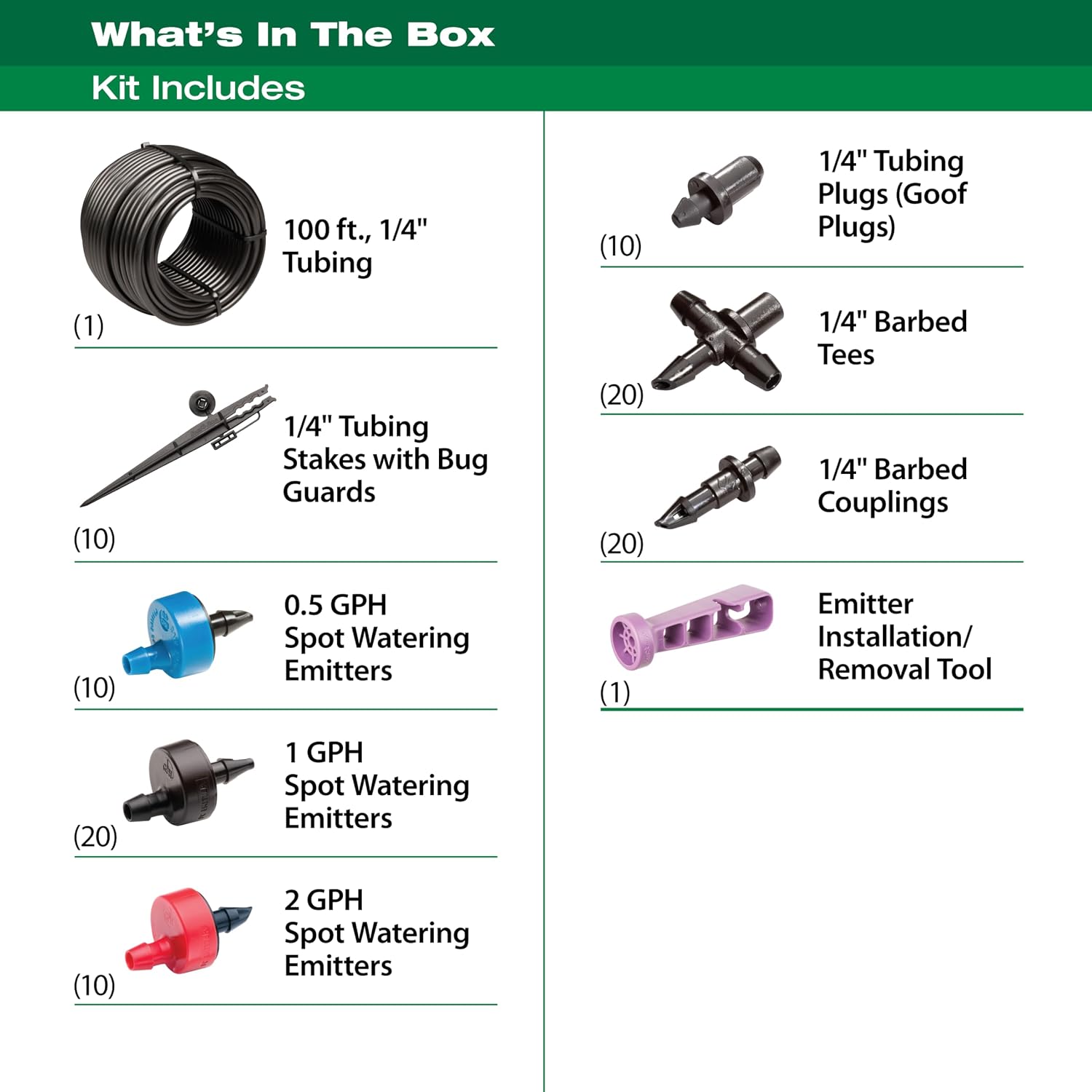
Prepackaged drip kits — products like the Rain Bird Drip Irrigation Retrofit Kit or the Orbit Drip System Kit — bundle a pressure regulator (a device that reduces line pressure to the 15–25 PSI range drip components need), a filter, tubing, emitters, and stakes into one box. They’re designed for simplicity. The tradeoff is that they assume average conditions and offer limited flexibility in emitter spacing or flow rate customization.
Component-built systems give you full control: you choose your header tubing diameter (typically ½-inch poly mainline), your emitter line or individual emitter type, and your exact GPH rating per emitter. The upfront learning curve is steeper, but the system is easier to troubleshoot and expand.
The decision rule:
- If you have 1–3 small raised beds (4×4 or 4×8 feet), 12 or fewer plants total, and you’re on a municipal supply with relatively consistent pressure: start with a quality kit. You’ll spend $40–$90 and be watering within an afternoon.
- If you have 4+ beds, garden rows longer than 20 feet, or you’re tying into an existing multi-zone controller like a Rachio 3 or Hunter Pro-HC: build component by component. The math below becomes your design foundation.
UC Agriculture and Natural Resources’ guide on drip irrigation for home gardens recommends keeping system pressure at the inlet between 15 and 30 PSI for standard drip emitters — always verify this at the faucet or valve outlet before designing, not after.
The Emitter Math You Actually Need
This is where most guides lose the plot. They tell you to “space emitters 12–18 inches apart” without explaining why that spacing matters or what happens when you get it wrong. Let’s fix that.
Your GPM Budget Comes First
Every zone is limited by the flow rate your water supply can deliver. Flow rate is measured in gallons per minute (GPM). Before you place a single emitter, you need to know your available GPM at the valve serving this zone.
Quick field test: time how long it takes to fill a 5-gallon bucket at the hose bib or valve outlet. Divide 5 by the number of seconds, then multiply by 60 to get GPM.
Example: 5 gallons fills in 40 seconds → 5 ÷ 40 × 60 = 7.5 GPM available
Colorado State University Extension’s guide on drip irrigation for home gardens recommends designing to no more than 75% of your available flow — so in this example, you’d budget 5.6 GPM (7.5 × 0.75) for the zone.
Converting GPM to Emitter Count
Drip emitters are rated in GPH (gallons per hour), not GPM. Convert your zone budget:
5.6 GPM × 60 minutes = 336 GPH available
Now divide by your emitter GPH rating. Common choices:
| Emitter GPH | Use case |
|---|---|
| 0.5 GPH | Seedlings, herbs, shallow-rooted annuals |
| 1.0 GPH | Most vegetables, tomatoes, peppers |
| 2.0 GPH | Squash, melons, large transplants |
At 1.0 GPH per emitter: 336 GPH ÷ 1.0 = up to 336 emitters per zone
That’s more than most raised-bed setups will ever use. But the math becomes critical when you’re running long garden rows — a 50-foot row of tomatoes with two emitters per plant at 18-inch spacing adds up to approximately 67 emitters × 1.0 GPH = 67 GPH. Multiply that across four rows and you’re at 268 GPH, well within budget but close enough that adding a fifth row warrants recalculation.
The rule: always total your GPH load before adding rows or beds. Running a zone over its flow budget causes the inlet pressure to drop, which means emitters at the far end of the run deliver less water than those at the head — a classic and completely avoidable mistake.
Emitter Spacing by Plant Type
Fine Gardening’s overview of drip irrigation basics notes that emitter placement should be driven by the plant’s root zone, not by uniform spacing for its own sake. For most raised-bed vegetables:
- Tomatoes, peppers, eggplant: 2 emitters per plant, positioned 4–6 inches out from the stem on opposite sides
- Squash, cucumbers, melons: 2–3 emitters per plant, placed at the drip line as the plant matures
- Lettuce, spinach, greens: 6-inch inline emitter tubing (also called drip tape or emitter line) run in parallel rows 6–8 inches apart — individual emitters are inefficient here
- Herbs: 1 emitter per plant, 0.5 GPH; overwatering basil and rosemary is easy with 1.0 GPH emitters
Tubing Layout for Raised Beds: The Patterns That Work
Layout is the physical expression of the math above. For a standard 4×8 raised bed, you have two reliable approaches:
Header-and-lateral layout: Run one ½-inch poly header line along the length of the bed. Branch ¼-inch micro-tubing off the header to each plant, terminating in a stake-mounted emitter. This is the most flexible approach — you can change emitter GPH ratings plant by plant. It’s also the layout most prepackaged kits use.
Inline emitter tubing (drip tape) layout: Run parallel rows of pre-spaced emitter tubing down the length of the bed. Each tube has emitters built in at fixed intervals (6, 9, or 12 inches). This is faster to install and works well for row crops like lettuce and carrots, but it’s harder to adjust if your plant spacing doesn’t match the emitter spacing.
For garden rows longer than 25 feet: Use pressure-compensating emitters or pressure-compensating drip tape. Standard (non-pressure-compensating) emitters deliver noticeably less water at the far end of a long run due to friction loss in the tubing. EPA WaterSense program guidance on water-efficient landscaping specifically highlights pressure compensation as a key factor in drip uniformity across longer runs.
One layout mistake to avoid: looping your ½-inch header into a closed rectangle around the bed perimeter sounds logical, but it creates unequal pressure at different lateral takeoff points unless you’re using pressure-compensating emitters throughout. If you’re using standard emitters, run the header as a single line down the center of the bed and branch laterals off both sides.
Buying Decision: What to Get and Where to Start
Here’s the direct answer by situation:
You have 1–3 raised beds and want to connect to a hose bib: The Rain Bird DIG drip conversion kits (available through Sprinkler Supply Store and IrrigationDirect) include a pressure regulator, Y-filter, and enough ¼-inch tubing and emitters to cover a 4×8 bed. Budget $50–$85. Add a battery-operated timer ($25–$45 for a Rain Bird or Orbit model) if you’re not tying into a controller.
You’re adding a drip zone to an existing smart controller: Wire a 24VAC valve (Hunter PGV-101G or Rain Bird EFB-CP-100 are well-regarded choices among landscape contractors for this application) into your controller’s zone terminals. Run ½-inch poly mainline from the valve to your bed area. Use a pressure regulator rated for 25 PSI at the zone inlet — Rain Bird’s 25 PSI ½-inch inline regulator is a commonly specified component for this application. Build out emitters from there using the math above.
You’re setting up a market garden or multi-row production space: At this scale, drip tape is your friend. Netafim and DripWorks both manufacture 15-mil tape rated for multiple seasons. Run your flow calculations by row, group rows of similar crops on the same valve, and consider a dedicated drip manifold with individual flow controls per row. Budget $200–$600 for a 4–8 row setup depending on row length.
The pressure regulator is not optional. Standard household water pressure runs 40–80 PSI. Most drip emitters are rated for 15–25 PSI maximum. Without a regulator, you’ll blow emitters off their barbed fittings within a season — a failure mode owners across review forums report consistently. It’s a $12–$18 part that protects everything downstream.
The Short Version Before You Order
Drip irrigation for raised beds rewards the installer who does the math first. Measure your GPM at the source. Set your zone budget at 75% of that number. Convert to GPH. Count your emitters. Choose your layout based on crop type — header-and-lateral for mixed vegetables, inline tape for row crops. Always add a pressure regulator. And if you’re building more than two or three beds, give each bed grouping its own valve on your controller so you can dial in schedules independently as the season changes.
The system you build this way will outperform any “set it and forget it” kit — and more importantly, it’ll be easy to troubleshoot when one row starts looking drier than the others. Because at that point, you’ll know exactly which emitter to check.